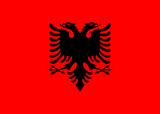
Albania – Facts, Capital & Geography | Random Country Generator
Capital
Tirana
Population
2.8 Million (#136)
Currency
Albanian Lek (ALL)
Language
Albanian
Area
28,748 km²
National Dish
Tavë Kosi
National Flower
Red Poppy
Density
98/km²
Internet TLD
.al
Brief History
Albania was inhabited by ancient Illyrian tribes before becoming part of the Roman and Byzantine empires. In the 15th century, national hero Skanderbeg led a decades-long rebellion against Ottoman conquest, though the territory remained under Ottoman rule until declaring independence in 1912. Following World War II, Albania became a highly isolated communist state under the dictatorship of Enver Hoxha, who built over 750,000 military bunkers. The nation transitioned to a multi-party democracy in 1991.
Key Demographics & Capital
Albania has a population of approximately 2.8 million. Around 60% live in urban areas, concentrated in the capital Tirana and the port city of Durrës. The country has seen significant emigration — roughly 1 in 4 Albanians now lives abroad, mainly in Italy, Greece, and Germany. Albanian is the official language; Gheg and Tosk are the two main dialects.
Geography
Albania is in Southeastern Europe on the Adriatic and Ionian coasts. The landscape features dramatic mountains, beautiful coastline (the Albanian Riviera), and Lake Ohrid — one of Europe's oldest and deepest lakes. About 70% of the country is mountainous. The Albanian Alps (Accursed Mountains) in the north are spectacular.
Culture & Tradition
Albanian culture blends Illyrian, Ottoman, and European influences. Hospitality (besa — keeping one's word) is a core cultural value. Albanian cuisine features byrek (phyllo pastry pie), tavë kosi (lamb with yogurt), and raki. The country has a unique tradition of sworn virgins and blood feuds (kanun law). Music includes iso-polyphony (UNESCO-recognized).
Economy
Albania's economy has grown steadily with services, tourism, agriculture, and manufacturing as key sectors. Tourism along the Riviera is booming. Agriculture remains important with olives, grapes, and livestock. The country is a candidate for EU membership. Hydroelectric power is the main energy source.
Travel Highlights
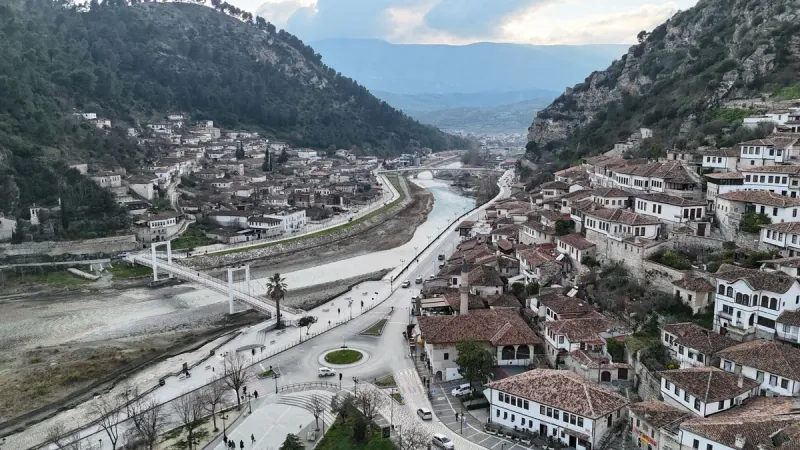
Explore the UNESCO city of Berat ('City of a Thousand Windows'), swim on the Albanian Riviera's pristine beaches, hike the Valbona-Theth trail in the Albanian Alps, visit ancient Butrint (UNESCO), discover communist-era bunkers, and explore vibrant Tirana. Albania is Europe's hidden gem with incredible value.
Fun Facts
Albania has over 750,000 bunkers built during the communist era.
Albanians nod to say 'no' and shake their heads to say 'yes.'
Mother Teresa was of Albanian descent.
Albania has one of the oldest lakes in the world (Lake Ohrid).
The country was one of the most isolated nations during the Cold War.
Albanian is one of the oldest languages in Europe.
Map
Bordering & Nearby Countries
Frequently Asked Questions (FAQs)
More from Europe
Want a surprise? Try our random Europe country generator or pick from the entire world.
Andorra
Explore Andorra: tiny mountain principality in the Pyrenees. Discover skiing, duty-free shopping, and Romanesque heritage.
Austria
Explore Austria: land of Mozart, Alpine peaks, and Viennese culture. Discover Salzburg, ski resorts, and Habsburg heritage.
Belarus
Explore Belarus: Europe's last primeval forest and medieval castles. Discover Belovezhskaya Pushcha, Mir Castle, and Slavic heritage.
Belgium
Explore Belgium: world-class chocolate, 1,500 beers, and medieval cities. Discover Brussels, Bruges, and Flemish artistic heritage.