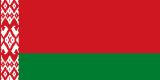
Belarus – Facts, Capital & Geography | Random Country Generator
Capital
Minsk
Population
9.2 Million (#97)
Currency
Belarusian Ruble (BYN)
Language
Belarusian, Russian
Area
207,600 km²
National Dish
Draniki
National Flower
Flax
Density
46/km²
Internet TLD
.by
Brief History
Belarus was part of Kievan Rus' in the Middle Ages, later incorporated into the Grand Duchy of Lithuania and the Polish-Lithuanian Commonwealth. Following the partitions of Poland in the late 18th century, it was annexed by the Russian Empire. Belarus declared a short-lived republic in 1918 before becoming a founding member of the Soviet Union in 1922. The nation suffered immense devastation during WWII and declared full sovereignty in 1991.
Key Demographics & Capital
Belarus has a population of approximately 9.2 million, with ethnic Belarusians comprising over 84% of the population, followed by Russian and Polish minorities. Both Belarusian and Russian are official languages, though Russian is dominant in daily communication and administration. The population is highly urbanized, with over 79% of residents living in cities, and nearly 2 million concentrated in the capital Minsk.
Geography
Belarus is a landlocked country in Eastern Europe. The landscape is predominantly flat with vast forests covering about 40% of the country, extensive wetlands, and thousands of rivers and lakes. The Pripyat Marshes in the south are one of Europe's largest wetland areas. Belovezhskaya Pushcha is Europe's last primeval forest.
Culture & Tradition
Belarusian culture reflects Slavic traditions. The Belovezhskaya Pushcha forest and its European bison are national symbols. Traditional crafts include straw weaving and linen production. Belarusian cuisine features draniki (potato pancakes), machanka (pork stew), and kvass. Soviet-era architecture dominates Minsk's cityscape.
Economy
Belarus has a state-controlled economy with manufacturing (trucks, tractors, machinery), agriculture, and IT services as key sectors. The IT sector has produced successful companies and Minsk has been called 'Silicon Valley of Eastern Europe.' Potash and petroleum refining are important. Trade with Russia is significant.
Travel Highlights
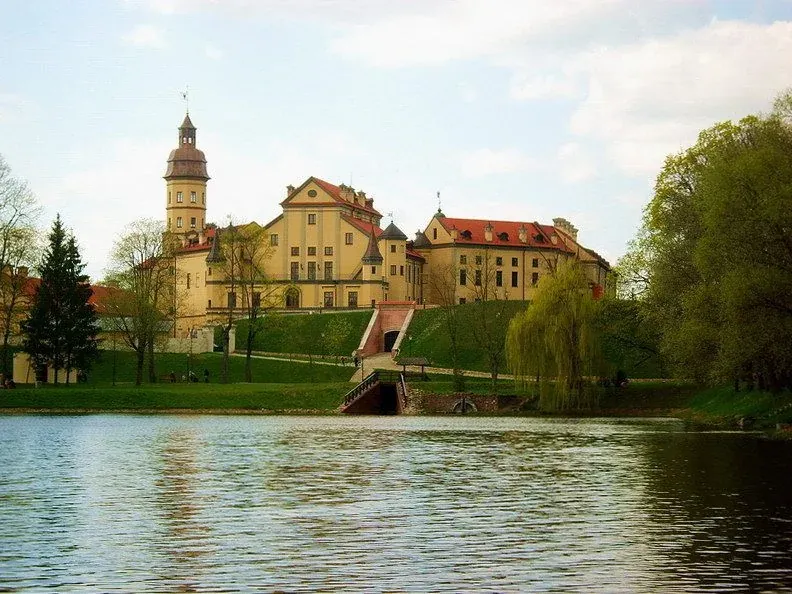
Explore the primeval Belovezhskaya Pushcha forest (UNESCO) and see European bison, discover Mir Castle (UNESCO), visit the medieval Nesvizh Palace, tour Minsk's Soviet-era architecture and vibrant restaurant scene, and explore the Brest Fortress WWII memorial. Belarus offers underexplored European heritage.
Fun Facts
Belarus is called the 'lungs of Europe' for its vast forests.
Belovezhskaya Pushcha is Europe's last primeval forest.
Belarus has one of the highest literacy rates in the world.
The European bison (wisent) was saved from extinction in Belarus.
Minsk was almost completely rebuilt after WWII.
Belarus has the world's largest dump truck (BelAZ).
Map
Bordering & Nearby Countries
Frequently Asked Questions (FAQs)
More from Europe
Want a surprise? Try our random Europe country generator or pick from the entire world.
Albania
Explore Albania: Europe's last hidden gem. Discover pristine beaches, ancient cities, and dramatic Albanian Alps.
Andorra
Explore Andorra: tiny mountain principality in the Pyrenees. Discover skiing, duty-free shopping, and Romanesque heritage.
Austria
Explore Austria: land of Mozart, Alpine peaks, and Viennese culture. Discover Salzburg, ski resorts, and Habsburg heritage.
Belgium
Explore Belgium: world-class chocolate, 1,500 beers, and medieval cities. Discover Brussels, Bruges, and Flemish artistic heritage.