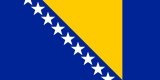
Bosnia and Herzegovina – Facts, Capital & Geography | Random Country Generator
Capital
Sarajevo
Population
3.2 Million (#132)
Currency
Convertible Mark (BAM)
Language
Bosnian, Serbian, Croatian
Area
51,209 km²
National Dish
Ćevapi
National Flower
Lily
Density
68/km²
Internet TLD
.ba
Brief History
Bosnia and Herzegovina was inhabited by Illyrians before Roman conquest, establishing a medieval kingdom in the 14th century under Tvrtko I. It was ruled by the Ottoman Empire from 1463 to 1878, leading to widespread conversions to Islam. Annexation by Austria-Hungary in 1908 sparked nationalist tensions, culminating in the assassination of Archduke Franz Ferdinand in Sarajevo. Following WWII, it became part of Yugoslavia, declaring independence in 1992 which led to a devastating civil war.
Key Demographics & Capital
Bosnia and Herzegovina has a population of approximately 3.2 million, composed of three main ethnic groups officially designated as 'constituent peoples': Bosniaks (about 51%), Serbs (31%), and Croats (15%). The three official languages—Bosnian, Serbian, and Croatian—are mutually intelligible. The population has declined significantly in recent decades due to low birth rates and high emigration rates among young professionals.
Geography
Bosnia and Herzegovina is in Southeastern Europe on the Balkan Peninsula. The landscape is predominantly mountainous with the Dinaric Alps running through the country. Dense forests cover about 50% of the territory. The country has a tiny coastline (20 km) at Neum. Rivers including the Neretva and Una carve dramatic canyons.
Culture & Tradition
Bosnian culture reflects the meeting point of Eastern and Western civilizations. Sarajevo is known for its multicultural heritage with mosques, churches, and synagogues in close proximity. Bosnian cuisine features ćevapi (grilled meat), burek (phyllo pastry), and Bosnian coffee. The country's turbulent recent history has shaped a resilient cultural identity.
Economy
Bosnia's economy is recovering and developing with manufacturing, energy, tourism, and agriculture as key sectors. Metal processing, furniture, and automotive components are important exports. Tourism is growing, particularly adventure and cultural tourism. The country has significant hydroelectric and wind energy potential.
Travel Highlights
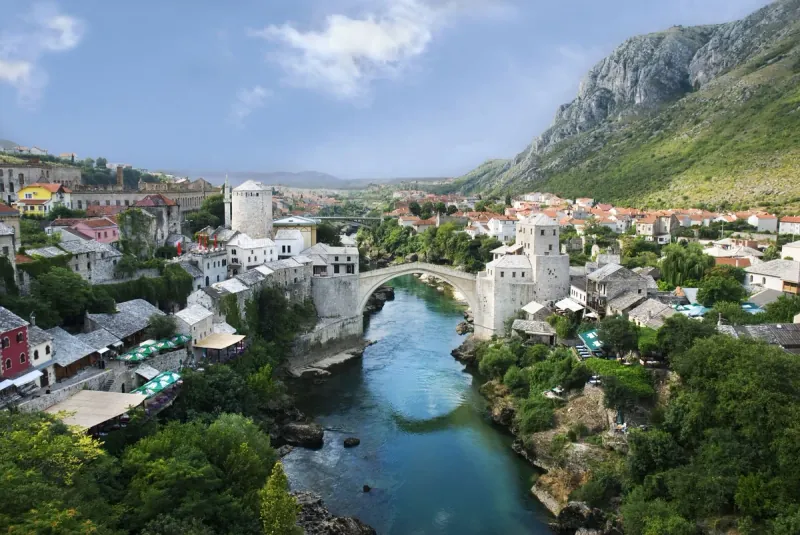
Walk across Mostar's iconic Stari Most bridge, explore Sarajevo's old bazaar (Baščaršija), raft the Una River, hike in Sutjeska National Park (home to Europe's last primeval forest), visit the Kravice waterfalls, and discover the medieval tombstones (stećci) scattered across the countryside (UNESCO).
Fun Facts
Sarajevo hosted the 1984 Winter Olympics.
The assassination of Archduke Franz Ferdinand in Sarajevo triggered WWI.
The Old Bridge in Mostar was rebuilt after its destruction in 1993.
Bosnia has some of Europe's last virgin forests.
Sarajevo was besieged for 1,425 days during the 1990s war.
The country has the highest percentage of minefields of any European nation.
Map
Bordering & Nearby Countries
Frequently Asked Questions (FAQs)
More from Europe
Want a surprise? Try our random Europe country generator or pick from the entire world.
Albania
Explore Albania: Europe's last hidden gem. Discover pristine beaches, ancient cities, and dramatic Albanian Alps.
Andorra
Explore Andorra: tiny mountain principality in the Pyrenees. Discover skiing, duty-free shopping, and Romanesque heritage.
Austria
Explore Austria: land of Mozart, Alpine peaks, and Viennese culture. Discover Salzburg, ski resorts, and Habsburg heritage.
Belarus
Explore Belarus: Europe's last primeval forest and medieval castles. Discover Belovezhskaya Pushcha, Mir Castle, and Slavic heritage.