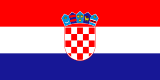
Croatia – Facts, Capital & Geography | Random Country Generator
Capital
Zagreb
Population
3.9 Million (#127)
Currency
Euro (EUR)
Language
Croatian
Area
56,594 km²
National Dish
Peka
National Flower
Iris croatica
Density
73/km²
Internet TLD
.hr
Brief History
Croatia emerged as a medieval duchy in the 7th century, unified as a kingdom under Tomislav in 925. It entered a personal union with Hungary in 1102 and was later incorporated into the Habsburg Monarchy and the Austro-Hungarian Empire. Following WWI, Croatia became a constituent republic of Yugoslavia, fighting a war of independence from 1991 to 1995 to secure modern sovereignty, subsequently joining the European Union in 2013.
Key Demographics & Capital
Croatia has a population of approximately 3.9 million, exhibiting high ethnic homogeneity with over 90% identifying as Croats, followed by a small Serb minority. Croatian is the sole official language, written in the Latin alphabet. The population is decline due to a combination of low birth rates and significant emigration to wealthier EU countries. Around 58% of the population lives in urban areas.
Geography
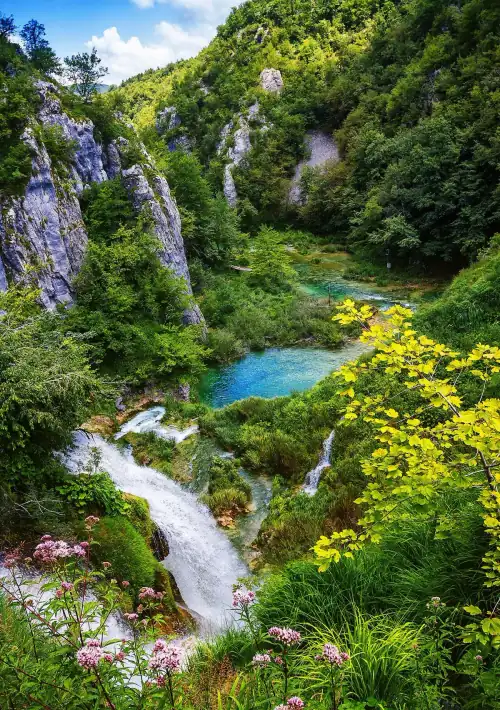
Croatia has a distinctive crescent shape along the Adriatic Sea. The coastline features over 1,200 islands, historic port cities, and crystal-clear waters. Inland, the landscape includes the Pannonian Plain in the east and mountains in the central region. Plitvice Lakes National Park features stunning cascading lakes and waterfalls.
Culture & Tradition
Croatian culture blends Mediterranean, Central European, and Balkan influences. The Dalmatian coast has Venetian and Roman architectural heritage. Croatian cuisine varies by region — seafood along the coast, heartier fare inland. Traditional klapa singing is UNESCO-recognized. Football is the national sporting passion (2018 World Cup runners-up).
Economy
Croatia's economy is driven by tourism (one of Europe's most popular destinations), shipbuilding, food processing, and IT. Adriatic coast tourism generates significant revenue. Agriculture includes wine, olive oil, and truffles. Croatia joined the EU in 2013 and adopted the euro in 2023.
Travel Highlights
Walk the walls of Dubrovnik's Old City, swim in the cascading Plitvice Lakes, island-hop in the Adriatic (Hvar, Korčula, Vis), explore Diocletian's Palace in Split, discover Istria's truffle country, and sail the coastline. Croatia offers Mediterranean beauty with excellent value.
Fun Facts
Dubrovnik was a filming location for Game of Thrones (King's Landing).
Croatia invented the necktie (cravat).
Plitvice Lakes has 16 cascading lakes connected by waterfalls.
Croatia has over 1,200 islands.
The Dalmatian dog breed is named after Croatia's Dalmatia region.
Zagreb has one of the world's shortest funiculars.
Map
Bordering & Nearby Countries
Frequently Asked Questions (FAQs)
More from Europe
Want a surprise? Try our random Europe country generator or pick from the entire world.
Albania
Explore Albania: Europe's last hidden gem. Discover pristine beaches, ancient cities, and dramatic Albanian Alps.
Andorra
Explore Andorra: tiny mountain principality in the Pyrenees. Discover skiing, duty-free shopping, and Romanesque heritage.
Austria
Explore Austria: land of Mozart, Alpine peaks, and Viennese culture. Discover Salzburg, ski resorts, and Habsburg heritage.
Belarus
Explore Belarus: Europe's last primeval forest and medieval castles. Discover Belovezhskaya Pushcha, Mir Castle, and Slavic heritage.