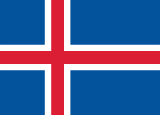
Iceland – Facts, Capital & Geography | Random Country Generator
Capital
Reykjavik
Population
380K (#171)
Currency
Icelandic Króna (ISK)
Language
Icelandic
Area
103,000 km²
National Dish
Skyr with Hákarl
National Flower
Mountain Avens
Density
3/km²
Internet TLD
.is
Brief History
Iceland was settled by Norwegian Norsemen and Celtic populations in the late 9th century, establishing the Althing in 930 CE, the world's oldest parliamentary institution. It entered a union with Norway in 1262 and later came under Danish rule in 1380. Iceland achieved home rule in 1918 and declared full independence as a republic on June 17, 1944, leveraging its maritime resources to develop a modern welfare state.
Key Demographics & Capital
Iceland has a population of approximately 390,000 residents, making it one of the most sparsely populated countries in the world. Icelandic is the sole official language, preserving grammatical structures virtually unchanged since the 9th century. The population has seen increasing immigrant diversity (about 15% foreign-born, primarily Polish). Around 94% of the population lives in urban areas, mainly Reykjavik.
Geography
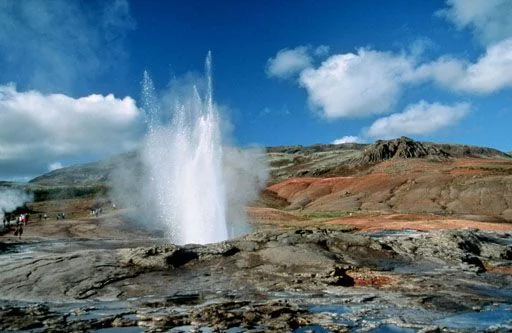
Iceland is a volcanic island in the North Atlantic, sitting on the Mid-Atlantic Ridge where the Eurasian and North American tectonic plates meet. The landscape features active volcanoes, geysers, hot springs, glaciers, lava fields, and dramatic waterfalls. About 11% of the country is covered by glaciers. Despite its name, Iceland has a relatively mild climate thanks to the Gulf Stream.
Culture & Tradition
Icelandic culture is deeply connected to Norse heritage and nature. The sagas — medieval Icelandic literature — are a national treasure. Icelanders maintain close ties to their Viking ancestry and language (modern Icelandic is very similar to Old Norse). Music (Björk, Sigur Rós), contemporary art, and a thriving literary scene define modern Icelandic culture. Bathing in hot springs is a cherished tradition.
Economy
Iceland's economy is based on fishing (historically the backbone), tourism (which boomed after the 2010 volcanic eruption), renewable energy (geothermal and hydroelectric power), and aluminum smelting. The country has one of the highest standards of living globally. Tech and creative industries are growing. Iceland's economy recovered remarkably after the 2008 financial crisis.
Travel Highlights
Drive the Golden Circle (Thingvellir, Geysir, Gullfoss), chase the northern lights, soak in the Blue Lagoon, explore the Jökulsárlón glacier lagoon, hike in Landmannalaugar's colorful mountains, and walk between tectonic plates at Silfra. The Ring Road circumnavigates the island past waterfalls, black sand beaches, and volcanic landscapes.
Fun Facts
Iceland has no mosquitoes.
About 60% of Iceland's population lives in the Reykjavik area.
Iceland uses geothermal energy for most of its heating.
There are no forests in Iceland — Vikings cut them down.
Iceland's parliament (Althing) is one of the oldest in the world, founded in 930 AD.
Icelanders read more books per capita than any other nation.
Map
Bordering & Nearby Countries
Frequently Asked Questions (FAQs)
More from Europe
Want a surprise? Try our random Europe country generator or pick from the entire world.
Albania
Explore Albania: Europe's last hidden gem. Discover pristine beaches, ancient cities, and dramatic Albanian Alps.
Andorra
Explore Andorra: tiny mountain principality in the Pyrenees. Discover skiing, duty-free shopping, and Romanesque heritage.
Austria
Explore Austria: land of Mozart, Alpine peaks, and Viennese culture. Discover Salzburg, ski resorts, and Habsburg heritage.
Belarus
Explore Belarus: Europe's last primeval forest and medieval castles. Discover Belovezhskaya Pushcha, Mir Castle, and Slavic heritage.