
Ireland – Facts, Capital & Geography | Random Country Generator
Capital
Dublin
Population
5.1 Million (#122)
Currency
Euro (EUR)
Language
Irish, English
Area
70,273 km²
National Dish
Irish Stew
National Flower
Shamrock
Density
72/km²
Internet TLD
.ie
Brief History
Ireland was settled by Celtic tribes in the late iron age, adopting Christianity in the 5th century under Saint Patrick. Anglo-Norman invasions began in 1169, initiating centuries of English colonial rule marked by land confiscations and the Great Famine of 1845–1849. The Easter Rising of 1916 and the War of Independence led to the partition of the island and the establishment of the Irish Free State in 1922, declaring a republic in 1949.
Key Demographics & Capital
Ireland has a population of approximately 5.1 million, with English and Irish (Gaeilge) serving as the official languages. While English is dominant, Irish is taught in schools and spoken natively in coastal regions (Gaeltacht). The population has grown rapidly in recent decades due to economic prosperity and significant immigration, with about 17% of residents born outside the country.
Geography
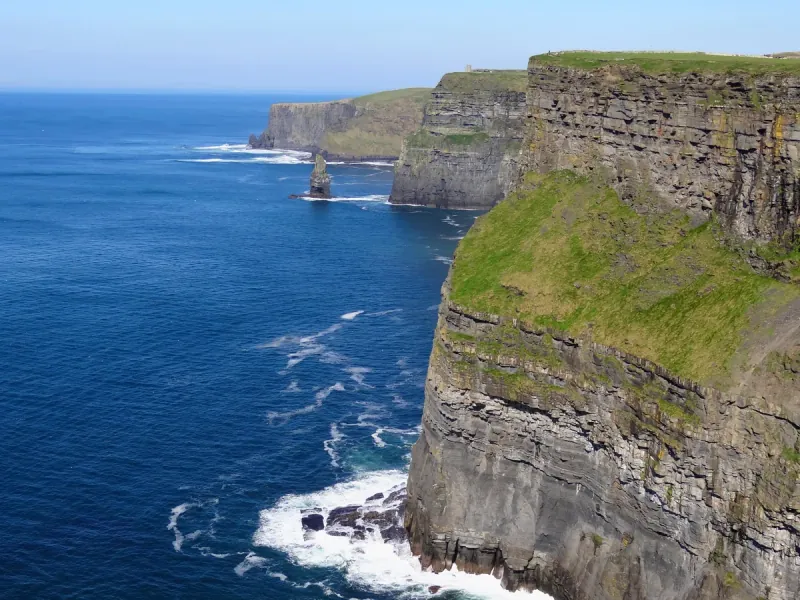
Ireland occupies most of the island of Ireland in the North Atlantic. The landscape features a central plain surrounded by coastal mountains. The west coast (Wild Atlantic Way) has dramatic cliffs, including the famous Cliffs of Moher. The country is known for its green rolling hills, peat bogs, and numerous lakes and rivers.
Culture & Tradition
Irish culture is renowned for its literature (Joyce, Wilde, Yeats), music (traditional sessions in pubs), dance (Riverdance), and warm hospitality. The pub is the center of social life. Irish mythology and folklore (leprechauns, fairies) are rich. Gaelic sports (hurling, Gaelic football) are passionately followed. St. Patrick's Day is celebrated globally.
Economy
Ireland has transformed from an agricultural economy to a knowledge-based one. It is the European headquarters for many tech giants (Apple, Google, Facebook, Microsoft). Pharmaceuticals, financial services, and agribusiness are key sectors. Tourism is significant. Ireland's low corporate tax rate has attracted substantial foreign investment.
Travel Highlights
Drive the Wild Atlantic Way, stand at the Cliffs of Moher, explore Dublin's literary pubs and Trinity College (Book of Kells), kiss the Blarney Stone, discover the Ring of Kerry, visit the Aran Islands, and tour the Guinness Storehouse. Traditional music sessions in village pubs offer authentic Irish experiences.
Fun Facts
Ireland is called the 'Emerald Isle' for its lush green landscape.
Halloween originated from the Irish Celtic festival of Samhain.
Ireland has no snakes — legend credits St. Patrick.
The Irish pub culture is famous worldwide.
Ireland has won the Eurovision Song Contest seven times.
The Book of Kells is over 1,200 years old.
Map
Bordering & Nearby Countries
Frequently Asked Questions (FAQs)
More from Europe
Want a surprise? Try our random Europe country generator or pick from the entire world.
Albania
Explore Albania: Europe's last hidden gem. Discover pristine beaches, ancient cities, and dramatic Albanian Alps.
Andorra
Explore Andorra: tiny mountain principality in the Pyrenees. Discover skiing, duty-free shopping, and Romanesque heritage.
Austria
Explore Austria: land of Mozart, Alpine peaks, and Viennese culture. Discover Salzburg, ski resorts, and Habsburg heritage.
Belarus
Explore Belarus: Europe's last primeval forest and medieval castles. Discover Belovezhskaya Pushcha, Mir Castle, and Slavic heritage.