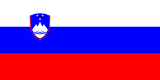
Slovenia – Facts, Capital & Geography | Random Country Generator
Capital
Ljubljana
Population
2.1 Million (#145)
Currency
Euro (EUR)
Language
Slovenian
Area
20,271 km²
National Dish
Potica
National Flower
Red Carnation
Density
104/km²
Internet TLD
.si
Brief History
Slovenia was ruled by the Holy Roman Empire and later the Habsburg Monarchy for centuries, serving as a peripheral alpine province of Austria. Following the collapse of Austria-Hungary in 1918, it joined the Kingdom of Serbs, Croats, and Slovenes (later Yugoslavia). Slovenia was the first Yugoslav republic to declare independence on June 25, 1991, fighting a brief Ten-Day War, subsequently joining the EU in 2004.
Key Demographics & Capital
Slovenia has a population of approximately 2.1 million, exhibiting high ethnic homogeneity with ethnic Slovenes comprising over 83% of the population. Slovene, a South Slavic language, is the sole official national language. The population has seen increasing immigrant diversity in recent years (about 12% foreign-born). Around 55% of the population lives in urban areas, concentrated around Ljubljana.
Geography
Slovenia is a small, diverse country at the crossroads of the Alps, Mediterranean, Pannonian Plain, and Dinaric Karst. The Julian Alps in the northwest include Mount Triglav (2,864m). The karst landscape in the south features extensive cave systems. The country has a tiny Adriatic coastline and significant forest cover (over 60%).
Culture & Tradition
Slovenian culture values nature, sustainability, and quality of life. Ljubljana is a charming capital with a car-free center and dragon bridge. Wine production is significant, with unique grape varieties. Slovenian cuisine blends Alpine, Mediterranean, and Central European flavors — potica (nut roll), štruklji (rolled dumplings), and Kraški pršut (karst prosciutto).
Economy
Slovenia has one of the highest GDPs per capita among former socialist countries. Key sectors include automotive parts, pharmaceuticals, electronics, and tourism. The country is known for high-quality manufacturing. Ljubljana has a growing tech and startup scene. Green tourism is a national priority.
Travel Highlights
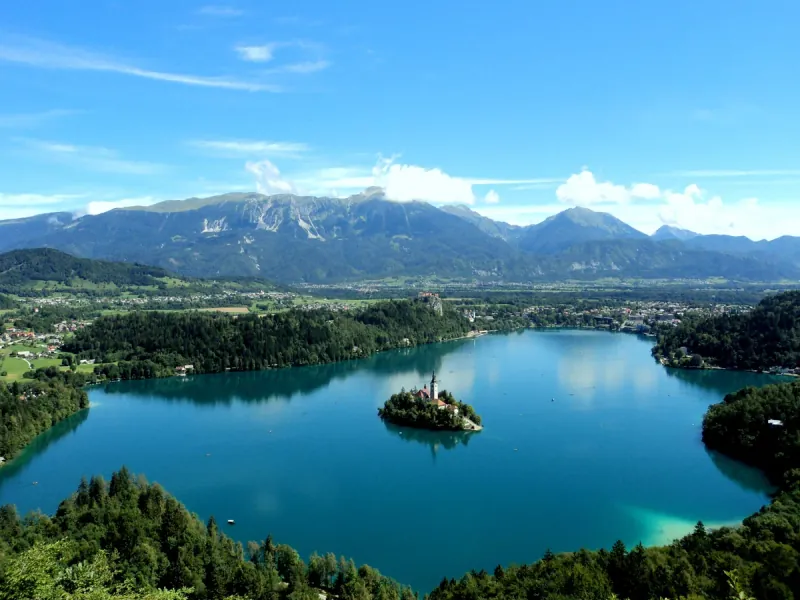
Row to the island church on Lake Bled, explore Postojna Cave and Predjama Castle, hike in Triglav National Park, discover Ljubljana's green and car-free city center, taste wine in the Vipava Valley, and explore the Škocjan Caves (UNESCO). Slovenia is a compact country with extraordinary diversity.
Fun Facts
Slovenia has over 10,000 caves, including the famous Postojna Cave.
Lake Bled with its island church is one of Europe's most photographed sites.
Slovenia is one of the greenest countries in the world.
Lipizzaner horses originated in Slovenia.
Slovenia has only 47 km of coastline.
The country was the first Eastern European country to host a World Cup ski race.
Map
Bordering & Nearby Countries
Frequently Asked Questions (FAQs)
More from Europe
Want a surprise? Try our random Europe country generator or pick from the entire world.
Albania
Explore Albania: Europe's last hidden gem. Discover pristine beaches, ancient cities, and dramatic Albanian Alps.
Andorra
Explore Andorra: tiny mountain principality in the Pyrenees. Discover skiing, duty-free shopping, and Romanesque heritage.
Austria
Explore Austria: land of Mozart, Alpine peaks, and Viennese culture. Discover Salzburg, ski resorts, and Habsburg heritage.
Belarus
Explore Belarus: Europe's last primeval forest and medieval castles. Discover Belovezhskaya Pushcha, Mir Castle, and Slavic heritage.