Marshall Islands – Facts, Capital & Geography | Random Country Generator
Capital
Majuro
Population
42K (#187)
Currency
United States Dollar (USD)
Language
Marshallese, English
Area
181 km²
National Dish
Pandan Cake
National Flower
Plumeria
Density
295/km²
Internet TLD
.mh
Brief History
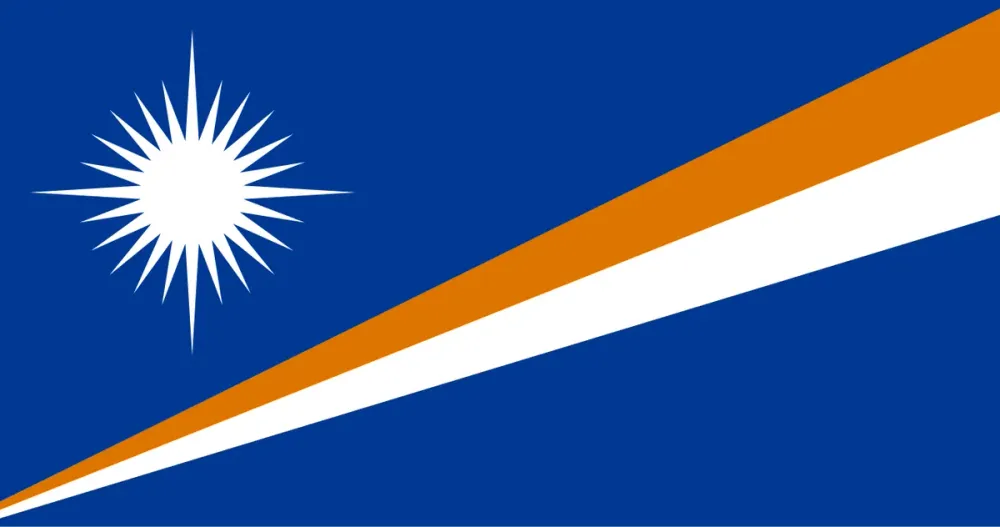
The Marshall Islands were inhabited by Micronesian navigators who used unique stick charts for ocean travel. The islands were claimed by Spain, sold to Germany in 1885, and captured by Japan during WWI, serving as a military base. Following WWII, the United States administered the territory under a UN trusteeship, conducting 67 nuclear tests (such as Castle Bravo) on Bikini Atoll. The nation achieved independence in 1986.
Key Demographics & Capital
The Marshall Islands has a population of approximately 42,000, with ethnic Marshallese comprising over 92% of the population. Both Marshallese and English are the official languages. The population is highly urbanized (78%), concentrated in the capital atoll of Majuro and in Ebeye Atoll, leading to high density. Significant emigration to the United States exists under Compact agreements.
Geography
The Marshall Islands is a chain of volcanic islands and coral atolls in the central Pacific Ocean. The 29 coral atolls and 5 islands are arranged in two chains: the Ratak (sunrise) and Ralik (sunset) chains. All islands are low-lying, averaging about 2 meters above sea level. The marine territory is vast.
Culture & Tradition
Marshallese culture is centered on the ocean. Traditional navigation using stick charts is a remarkable achievement. Canoe building and sailing are important cultural skills. The nuclear testing legacy at Bikini and Enewetak atolls has profoundly shaped national identity. Community and family ties are strong. Traditional weaving and shell crafts are practiced.
Economy
The Marshall Islands' economy depends on US Compact of Free Association payments, fishing license fees, copra, and aid. The country hosts the Ronald Reagan Ballistic Missile Defense Test Site at Kwajalein. Shipping registration provides revenue (one of the world's largest ship registries). Climate change poses an existential threat.
Travel Highlights
Dive the sunken WWII and nuclear fleet at Bikini Atoll (for experienced divers), explore Majuro's lagoon, visit the Alele Museum, experience traditional Marshallese culture, and discover remote atolls. The Marshall Islands offers extraordinary diving and authentic Pacific experiences for adventurous travelers.
Fun Facts
The Marshall Islands were used for US nuclear testing (1946-1958).
Bikini Atoll gave its name to the bikini swimsuit.
The country has the largest shark sanctuary in the world.
Marshallese stick charts were used for ocean navigation.
The Marshall Islands is one of the most nuclear-affected places on Earth.
The country has 29 coral atolls and 5 coral islands.
Map
Bordering & Nearby Countries
Frequently Asked Questions (FAQs)
More from Oceania
Want a surprise? Try our random Oceania country generator or pick from the entire world.

Australia
Explore Australia: from the Great Barrier Reef to the Outback. Discover unique wildlife, stunning landscapes, and vibrant cities.
Fiji
Explore Fiji: 330 islands of South Pacific paradise. Discover pristine reefs, warm Fijian hospitality, and tropical island adventures.
Kiribati
Explore Kiribati: remote Pacific atolls spanning the equator. Discover WWII history, traditional culture, and pristine ocean environments.
Micronesia
Explore Micronesia: Nan Madol's mystery and world-class diving. Discover WWII wrecks, stone money of Yap, and Pacific island traditions.