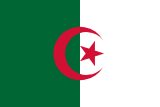
Algeria – Facts, Capital & Geography | Random Country Generator
Capital
Algiers
Population
44.6 Million (#34)
Currency
Algerian Dinar (DZD)
Language
Arabic, Berber
Area
2,381,741 km²
National Dish
Couscous
National Flower
Cyclamen
Density
18/km²
Internet TLD
.dz
Brief History
Algeria's rich history includes Numidian rule, Roman colonization, and the arrival of Islam under the Umayyad Caliphate. It was incorporated into the Ottoman Empire in the 16th century, serving as a major Barbary corsair base. French colonization began in 1830, leading to a brutal war of independence from 1954 to 1962, which ended with the Evian Accords and Algerian sovereignty. The country went through a major civil war in the 1990s and has since focused on political stabilization.
Key Demographics & Capital
Algeria has a population of over 45 million, with the vast majority of residents identifying as Arab-Berber. Algerian Arabic (Darja) is the official language, while Berber languages (Tamazight) are recognized as national languages and spoken by about 20% of the population. French is widely used in administrative, commercial, and educational contexts. Around 74% of the population is urbanized, clustered heavily along the narrow, fertile Mediterranean coast, while the Sahara region remains sparsely populated.
Geography
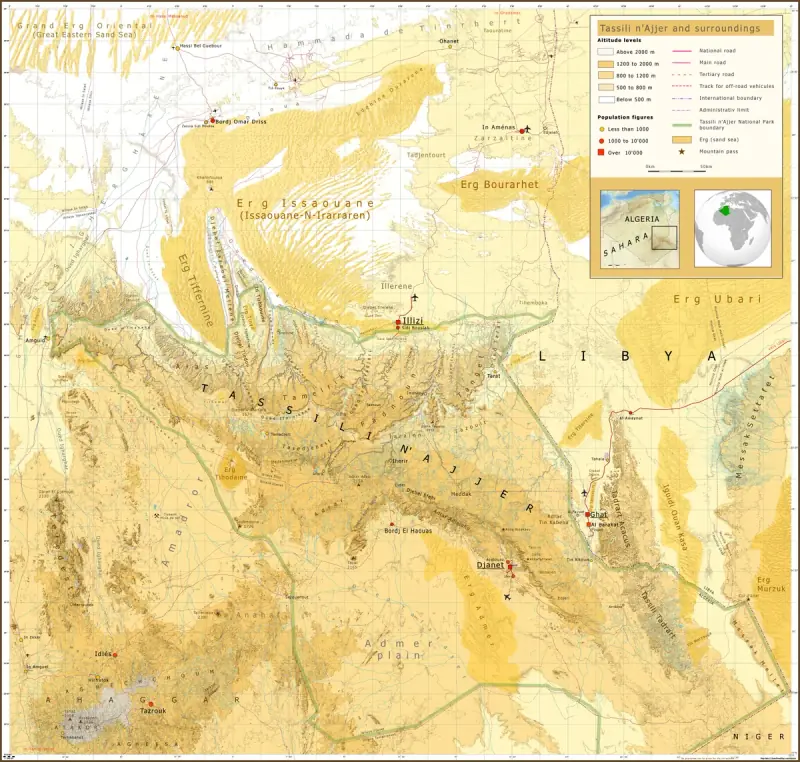
Algeria is the largest country in Africa, located in North Africa along the Mediterranean coast. The Tell Atlas mountains run along the northern coast, while the vast Sahara Desert dominates the south. The Hoggar Mountains in the southeast feature dramatic volcanic landscapes. The country has diverse terrain from fertile coastal plains to endless sand dunes.
Culture & Tradition
Algerian culture is a rich blend of Berber, Arab, Ottoman, and French influences. Traditional music includes Raï, which gained international recognition. Algerian cuisine features couscous, mechoui, and a variety of pastries. The country has a strong literary tradition, with Albert Camus and Kateb Yacine among its notable writers. Islamic architecture and Berber traditions are deeply woven into daily life.
Economy
Algeria's economy is heavily dependent on hydrocarbons, particularly natural gas and oil, which account for about 95% of export earnings. The government has been working to diversify into agriculture, tourism, and manufacturing. The country has significant mineral resources including iron ore, phosphates, and zinc.
Travel Highlights
Visit the ancient Roman ruins of Djémila and Timgad, explore the Casbah of Algiers (UNESCO site), trek through the stunning Tassili n'Ajjer rock formations in the Sahara, and experience the M'zab Valley's unique architecture. The Mediterranean coastline offers beautiful beaches, while the Sahara provides unforgettable desert experiences.
Fun Facts
Algeria is the largest country in Africa by area.
The Sahara Desert covers about 80% of Algeria.
Algeria has seven UNESCO World Heritage Sites.
The country has the longest coastline in Africa on the Mediterranean.
Algerian cuisine blends Berber, Arab, and French influences.
The ancient Roman ruins of Timgad are remarkably well-preserved.
Map
Bordering & Nearby Countries
Frequently Asked Questions (FAQs)
More from Africa
Want a surprise? Try our random Africa country generator or pick from the entire world.
Angola
Explore Angola: from Kalandula Falls to Atlantic beaches. Discover vibrant culture, wildlife, and Southern African landscapes.
Benin
Discover Benin: birthplace of Voodoo. Explore Dahomey palaces, floating villages, and rich West African traditions.
Botswana
Explore Botswana: home of the Okavango Delta and incredible safaris. Discover elephants, Kalahari landscapes, and African wilderness.
Burkina Faso
Discover Burkina Faso: Land of Honest People. Explore Africa's film capital, mask traditions, and Sahelian landscapes.