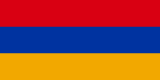
Armenia – Facts, Capital & Geography | Random Country Generator
Capital
Yerevan
Population
3.0 Million (#134)
Currency
Armenian Dram (AMD)
Language
Armenian
Area
29,743 km²
National Dish
Dolma
National Flower
Forget-Me-Not
Density
103/km²
Internet TLD
.am
Brief History
Armenia is home to one of the world's oldest civilizations, with the Kingdom of Urartu flourishing in the 9th century BCE. In 301 CE, it became the first nation to officially adopt Christianity as its state religion under King Tiridates III. Over centuries, Armenia was partitioned between the Byzantine, Persian, Ottoman, and Russian empires, suffering the Armenian Genocide in 1915. It declared independence from the Soviet Union in 1991.
Key Demographics & Capital
Armenia has a population of approximately 2.9 million, exhibiting high ethnic homogeneity with over 98% of the population identifying as ethnic Armenian. Armenian is the official language and uses its own unique 36-letter alphabet created in 405 CE. The population is highly urbanized, with more than 63% living in urban centers, and over a third concentrated in the capital Yerevan. Significant Armenian diaspora communities exist worldwide.
Geography
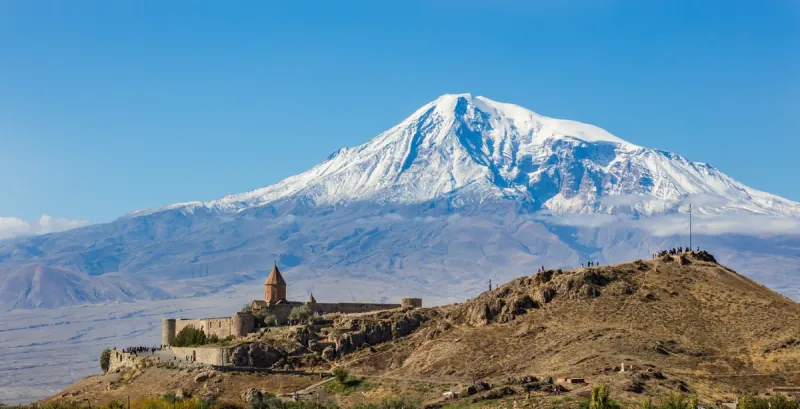
Armenia is a landlocked, mountainous country in the South Caucasus. The landscape is dominated by the Lesser Caucasus mountain range with volcanic plateaus. Lake Sevan, one of the largest high-altitude lakes in the world, is the country's largest body of water. The terrain features deep river gorges, forests, and alpine meadows.
Culture & Tradition
Armenian culture is one of the world's oldest, with Christianity adopted in 301 AD. Ancient monasteries and churches dot the landscape. The Armenian Genocide of 1915 profoundly shapes national identity. Armenian cuisine features lavash bread (UNESCO-recognized), dolma, and khorovats (barbecue). The duduk (woodwind instrument) is UNESCO-recognized. Art and manuscript traditions are rich.
Economy
Armenia's economy relies on mining (copper, molybdenum), IT and technology, agriculture, and diamond processing. The tech sector has grown rapidly, earning Yerevan the nickname 'Silicon Mountains.' Brandy production (Armenian cognac) is notable. Remittances from the large diaspora are important.
Travel Highlights
Visit the ancient temple of Garni and Geghard Monastery (UNESCO), take the Wings of Tatev aerial tramway, explore Yerevan's café culture and Cascade complex, discover Lake Sevan's island monastery, visit the Genocide Memorial, and hike in Dilijan National Park. Armenia offers accessible ancient heritage.
Fun Facts
Armenia was the first country to adopt Christianity as a state religion (301 AD).
Mount Ararat, where Noah's Ark is said to have landed, is visible from Yerevan but is in Turkey.
Armenia has one of the world's oldest wine-making traditions (over 6,000 years).
The Armenian alphabet was created in 405 AD.
Yerevan is older than Rome.
Armenia has the world's longest reversible aerial tramway (Wings of Tatev).
Map
Bordering & Nearby Countries
Frequently Asked Questions (FAQs)
More from Asia
Want a surprise? Try our random Asia country generator or pick from the entire world.
Afghanistan
Discover Afghanistan: Hindu Kush mountains and ancient Silk Road heritage. Explore Bamiyan Valley, Herat's architecture, and Afghan culture.
Azerbaijan
Explore Azerbaijan: Land of Fire. Discover Baku's Flame Towers, ancient walled city, mud volcanoes, and Caspian Sea heritage.

Bahrain
Explore Bahrain: ancient Dilmun heritage and modern Gulf culture. Discover pearl diving history, Formula One, and island archipelago charm.
Bangladesh
Discover Bangladesh: the Sundarbans, world's longest beach, and rich Bengali culture. Explore river delta landscapes and ancient heritage.