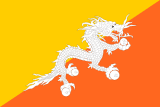
Bhutan – Facts, Capital & Geography | Random Country Generator
Capital
Thimphu
Population
780K (#160)
Currency
Bhutanese Ngultrum (BTN)
Language
Dzongkha
Area
38,394 km²
National Dish
Ema Datshi
National Flower
Blue Poppy
Density
20/km²
Internet TLD
.bt
Brief History
Bhutan's history is rooted in the early consolidation of Tibetan Buddhism, unified as a single state in the 17th century by Shabdrung Ngawang Namgyal. Bhutan defeated British incursions in the 18th and 19th centuries, signing the Treaty of Punakha in 1910 to secure internal autonomy while letting Britain guide external relations. The hereditary monarchy was established in 1907, and the nation transitioned to a democratic constitutional monarchy in 2008.
Key Demographics & Capital
Bhutan has a population of approximately 780,000, consisting of three main ethnic groups: the Ngalop in the west and north, the Sharchop in the east, and the Lhotshampa (of Nepalese descent) in the south. Dzongkha is the official language, written in the Tibetan Uchen script, while English is the medium of instruction in schools. The population remains predominantly rural (60%), concentrated in fertile western valleys.
Geography
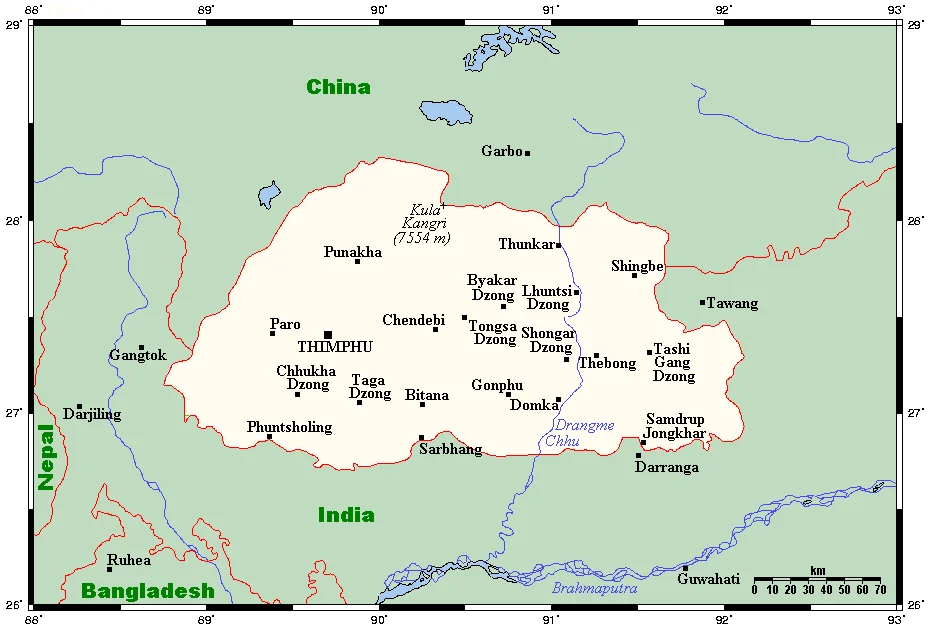
Bhutan is a small Himalayan kingdom between China and India. The terrain rises dramatically from subtropical plains in the south to the high Himalayas in the north, with peaks over 7,000 meters. Dense forests cover about 70% of the country. Glacial rivers carve deep valleys through the mountains.
Culture & Tradition
Bhutanese culture is deeply Buddhist, with dzongs (fortress-monasteries) dominating the landscape. Traditional dress (gho for men, kira for women) is required in formal settings. Archery is the national sport. Festivals (tshechus) feature masked dances and cultural celebrations. Bhutan prioritizes Gross National Happiness over economic growth.
Economy
Bhutan's economy relies on hydroelectric power (exported to India), agriculture, forestry, and tourism. The government limits tourist numbers through a daily sustainable development fee. Bhutan is the world's only carbon-negative country. Organic farming is a national priority.
Travel Highlights
Hike to the iconic Tiger's Nest Monastery (Paro Taktsang), explore the fortress-monasteries (dzongs), attend a colorful tshechu festival, trek in the Himalayas, visit the capital Thimphu, and experience the pristine Phobjikha Valley where black-necked cranes winter. Bhutan offers deeply spiritual and environmentally conscious travel.
Fun Facts
Bhutan measures success by Gross National Happiness instead of GDP.
Television was not introduced until 1999.
Bhutan is the only carbon-negative country in the world.
The Tiger's Nest monastery clings to a cliff at 3,120 meters.
Bhutan's national sport is archery.
The country was never colonized.
Map
Bordering & Nearby Countries
Frequently Asked Questions (FAQs)
More from Asia
Want a surprise? Try our random Asia country generator or pick from the entire world.
Afghanistan
Discover Afghanistan: Hindu Kush mountains and ancient Silk Road heritage. Explore Bamiyan Valley, Herat's architecture, and Afghan culture.
Armenia
Explore Armenia: first Christian nation. Discover ancient monasteries, Lake Sevan, and Caucasus mountain heritage.
Azerbaijan
Explore Azerbaijan: Land of Fire. Discover Baku's Flame Towers, ancient walled city, mud volcanoes, and Caspian Sea heritage.

Bahrain
Explore Bahrain: ancient Dilmun heritage and modern Gulf culture. Discover pearl diving history, Formula One, and island archipelago charm.