Cambodia – Facts, Capital & Geography | Random Country Generator
Capital
Phnom Penh
Population
17.0 Million (#72)
Currency
Cambodian Riel (KHR)
Language
Khmer
Area
181,035 km²
National Dish
Fish Amok
National Flower
Rumdul
Density
92/km²
Internet TLD
.kh
Brief History
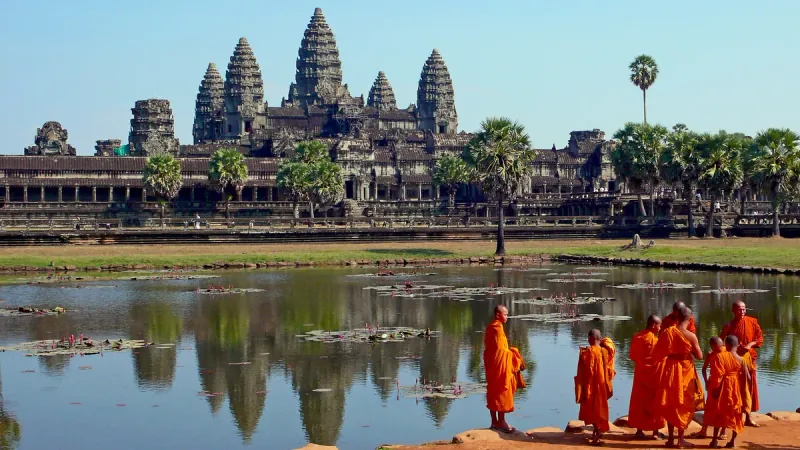
Cambodia was the seat of the Khmer Empire, which ruled much of mainland Southeast Asia from the 9th to 15th centuries and constructed the monumental Angkor Wat temple complex. Following centuries of decline, Cambodia became a French protectorate in 1863, gaining independence under King Norodom Sihanouk in 1953. The country was devastated by the genocidal Khmer Rouge regime under Pol Pot (1975–1979), transitioning back to a constitutional monarchy in 1993.
Key Demographics & Capital
Cambodia has a population of approximately 16.8 million, showing high ethnic homogeneity with over 97% identifying as ethnic Khmer. Khmer is the official language and is written in its own script (the longest alphabet in the world). The population is relatively young, reflecting recovery from the Khmer Rouge era, and is predominantly rural, with urbanization centered around the capital Phnom Penh.
Geography
Cambodia is in mainland Southeast Asia, dominated by the flat Tonlé Sap basin and Mekong River lowlands. The Tonlé Sap lake is Southeast Asia's largest freshwater lake, expanding dramatically during the monsoon. Mountains rise along the borders with Thailand and Vietnam. The coastline has tropical islands.
Culture & Tradition
Cambodian culture is deeply rooted in the Khmer Empire's legacy. Angkor Wat and the temple complex represent one of humanity's greatest architectural achievements. Apsara dance is a UNESCO-recognized traditional art. Cambodian cuisine features fish amok, lok lak, and prahok (fermented fish paste). Buddhism permeates daily life.
Economy
Cambodia's economy has grown rapidly, driven by garment manufacturing, tourism, agriculture (rice), and construction. Angkor Wat attracts millions of visitors annually. Agriculture employs a large portion of the population. The country is developing special economic zones to attract manufacturing investment.
Travel Highlights
Explore the magnificent Angkor Wat temple complex, visit the sobering Tuol Sleng Museum and Killing Fields, relax on the beaches of Sihanoukville and Koh Rong, discover floating villages on Tonlé Sap, and experience Phnom Penh's Royal Palace and riverside promenade. Battambang offers authentic rural experiences.
Fun Facts
Angkor Wat is the largest religious monument in the world.
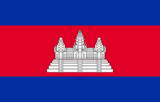
Cambodia's flag is the only one featuring a building.
Tonlé Sap lake doubles in size during the monsoon season.
The Khmer Empire was one of the most powerful in Southeast Asian history.
Cambodia has one of the youngest populations in Asia.
The country uses both the riel and US dollar as currency.
Map
Bordering & Nearby Countries
Frequently Asked Questions (FAQs)
More from Asia
Want a surprise? Try our random Asia country generator or pick from the entire world.
Afghanistan
Discover Afghanistan: Hindu Kush mountains and ancient Silk Road heritage. Explore Bamiyan Valley, Herat's architecture, and Afghan culture.
Armenia
Explore Armenia: first Christian nation. Discover ancient monasteries, Lake Sevan, and Caucasus mountain heritage.
Azerbaijan
Explore Azerbaijan: Land of Fire. Discover Baku's Flame Towers, ancient walled city, mud volcanoes, and Caspian Sea heritage.
Bahrain
Explore Bahrain: ancient Dilmun heritage and modern Gulf culture. Discover pearl diving history, Formula One, and island archipelago charm.