Chad – Facts, Capital & Geography | Random Country Generator
Capital
N'Djamena
Population
17.4 Million (#68)
Currency
Central African CFA Franc (XAF)
Language
French, Arabic
Area
1,284,000 km²
National Dish
Daraba
National Flower
Rose
Density
12/km²
Internet TLD
.td
Brief History
Chad was the seat of several powerful Saharan trade empires, including Kanem-Bornu, Wadai, and Baguirmi, which controlled trans-Saharan trade routes. French colonization began in 1900, culminating in Chad's status as an overseas territory before gaining independence in 1960. The country has since experienced chronic instability, including a long-running civil war, Libyan interventions, and border conflicts, led by Idriss Déby from 1990 to 2021.
Key Demographics & Capital
Chad has a population of approximately 18 million, composed of over 200 distinct ethnic groups, with the Sara in the south and Arab-descended groups in the north being the largest. Both French and Arabic are official languages, reflecting the country's cultural bridge between North Africa and sub-Saharan Africa. The population is overwhelmingly young and rural, concentrated in the southern agricultural zone.
Geography
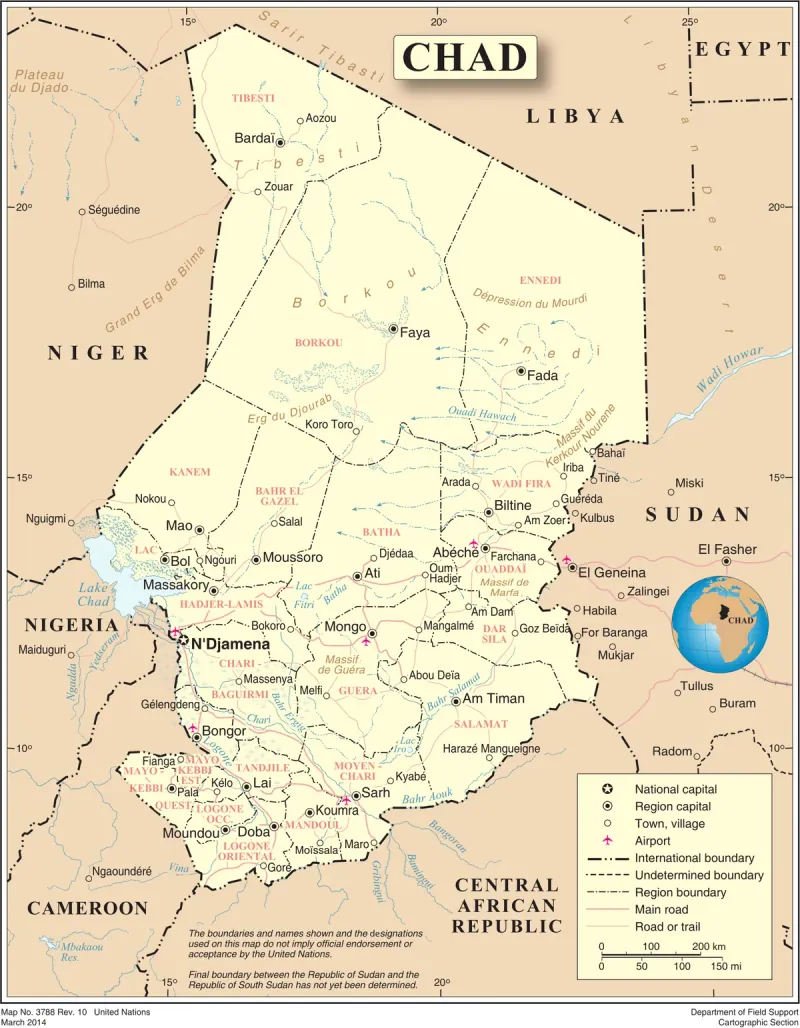
Chad is a large landlocked country in north-central Africa. The landscape ranges from the Sahara Desert in the north to tropical lowlands in the south. The Tibesti Mountains in the north include the highest peak in the Sahara. Lake Chad in the west has been dramatically shrinking. The Ennedi Plateau features stunning rock formations.
Culture & Tradition
Chad has remarkable cultural diversity with over 200 ethnic groups. Northern communities are predominantly Muslim with Arab and Tubu traditions, while southern groups practice Christianity and traditional religions. Music varies by region, with traditional instruments like the hu hu fiddle. Sara, Arab, and Toubou cultures each contribute distinct traditions.
Economy
Chad's economy relies heavily on oil exports, agriculture, and livestock herding. Cotton was historically the main export before oil production began. Most of the population practices subsistence agriculture. The country faces challenges from drought, desertification, and regional instability.
Travel Highlights
Explore the stunning Ennedi Plateau with its natural arches and ancient rock art, visit the shores of Lake Chad, discover the Tibesti Mountains, and experience the Zakouma National Park for wildlife. The Guelta d'Archei oasis in the desert is home to a population of Saharan crocodiles.
Fun Facts
Lake Chad has shrunk by 90% since the 1960s.
The Sahara Desert covers the northern third of Chad.
The Ennedi Plateau has spectacular natural rock arches.
Chad is home to one of the oldest hominid skulls ever found (Sahelanthropus tchadensis).
The country has over 200 ethnic groups.
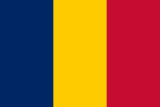
Chad's flag is nearly identical to Romania's.
Map
Bordering & Nearby Countries
Frequently Asked Questions (FAQs)
More from Africa
Want a surprise? Try our random Africa country generator or pick from the entire world.
Algeria
Discover Algeria: Africa's largest country. From Saharan landscapes to Mediterranean coasts, explore ancient ruins and Berber culture.
Angola
Explore Angola: from Kalandula Falls to Atlantic beaches. Discover vibrant culture, wildlife, and Southern African landscapes.
Benin
Discover Benin: birthplace of Voodoo. Explore Dahomey palaces, floating villages, and rich West African traditions.
Botswana
Explore Botswana: home of the Okavango Delta and incredible safaris. Discover elephants, Kalahari landscapes, and African wilderness.