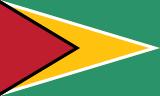
Guyana – Facts, Capital & Geography | Random Country Generator
Capital
Georgetown
Population
800K (#159)
Currency
Guyanese Dollar (GYD)
Language
English
Area
214,969 km²
National Dish
Pepperpot
National Flower
Victoria Amazonica
Density
4/km²
Internet TLD
.gy
Brief History
Guyana was originally settled by indigenous groups like the Caribs and Arawaks before Dutch traders established colonies in the 17th century, later ceded to Great Britain in 1814 as British Guiana. The British imported enslaved Africans to work on sugar plantations, and later indentured laborers from India after emancipation. Guyana achieved independence on May 26, 1966, under Forbes Burnham, transitioning to a cooperative republic in 1970.
Key Demographics & Capital
Guyana has a population of approximately 800,000, presenting a unique demographic composition reflecting colonial indentured migrations: about 40% are of Indian descent (Indo-Guyanese) and 29% of African descent (Afro-Guyanese). English is the sole official language, while Guyanese Creole is widely spoken. The population is highly concentrated along the narrow, fertile coastal strip.
Geography
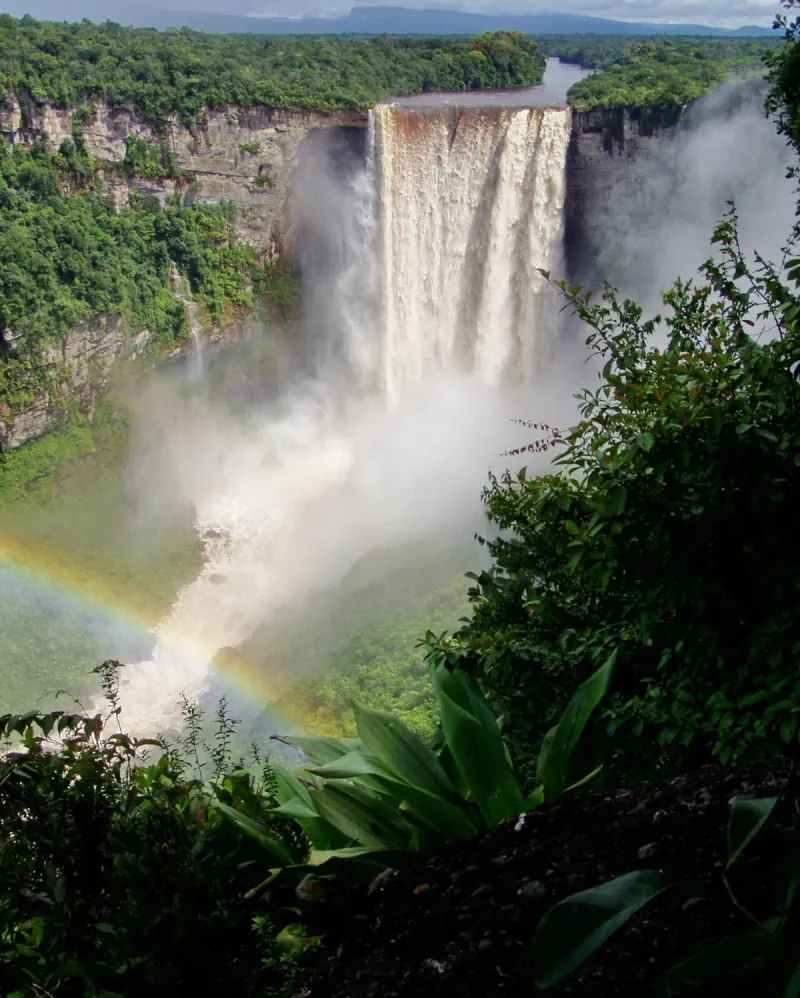
Guyana is on the northern coast of South America. Over 80% is covered by pristine tropical rainforest. The interior features the Pakaraima Mountains and the massive Kaieteur Falls (one of the world's tallest single-drop waterfalls). The coastal plain is below sea level and protected by seawalls. Major rivers include the Essequibo and Demerara.
Culture & Tradition
Guyanese culture is remarkably diverse with Indo-Guyanese, Afro-Guyanese, Indigenous, Chinese, and European communities. Cricket is the national passion. Cuisine reflects this diversity with curry, roti, cookup rice, and pepperpot. Mashramani (Republic Day) is celebrated with carnival-like festivities. The country maintains strong Caribbean cultural ties despite being in South America.
Economy
Guyana's economy has been transformed by massive offshore oil discoveries (ExxonMobil). Traditional sectors include agriculture (sugar, rice), mining (gold, bauxite, diamonds), and forestry. The oil boom is rapidly increasing GDP. Guyana has potential for ecotourism given its vast, pristine rainforest.
Travel Highlights
Fly over the spectacular Kaieteur Falls, explore Iwokrama Rainforest for jaguars and giant otters, visit the wooden colonial architecture of Georgetown, discover Indigenous communities in the interior, fish for arapaima, and experience the Rupununi savanna. Guyana offers South America's last great wilderness frontier.
Fun Facts
Guyana is the only English-speaking country in South America.
Kaieteur Falls is one of the world's most powerful waterfalls.
Over 80% of Guyana is covered by pristine rainforest.
Guyana has one of the lowest population densities in South America.
The country has six ethnic groups.
Guyana recently discovered massive offshore oil reserves.
Map
Bordering & Nearby Countries
Frequently Asked Questions (FAQs)
More from South America
Want a surprise? Try our random South America country generator or pick from the entire world.
Argentina
Discover Argentina: from Buenos Aires tango to Patagonian glaciers. Explore wine country, Iguazu Falls, and vibrant culture.
Bolivia
Explore Bolivia: the Salar de Uyuni and world's highest capital. Discover Lake Titicaca, indigenous culture, and Andean adventures.
Brazil
Discover Brazil: home of the Amazon, Carnival, and beautiful beaches. Explore culture, geography, and travel highlights.
Chile
Discover Chile: from the Atacama Desert to Patagonian glaciers. Explore Easter Island, wine country, and diverse landscapes.