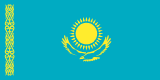
Kazakhstan – Facts, Capital & Geography | Random Country Generator
Capital
Astana
Population
19.6 Million (#63)
Currency
Kazakhstani Tenge (KZT)
Language
Kazakh, Russian
Area
2,724,900 km²
National Dish
Beshbarmak
National Flower
Tulip
Density
7/km²
Internet TLD
.kz
Brief History
Kazakhstan was inhabited by nomadic horse tribes, including the Golden Horde, before the Kazakh Khanate unified the region in the 15th century. It came under Russian colonial rule in the 18th century, later becoming the Kazakh Soviet Socialist Republic in 1936. Kazakhstan suffered from Soviet agricultural experiments and nuclear tests, declaring independence on December 16, 1991, as the last Soviet republic to do so.
Key Demographics & Capital
Kazakhstan has a population of approximately 19.8 million, presenting a diverse demographic mix: ethnic Kazakhs comprise over 70% of the population, followed by a significant Russian minority (about 15.5%). Kazakh is the state language, while Russian is recognized as an official language of inter-ethnic communication and remains dominant in business and urban administration.
Geography
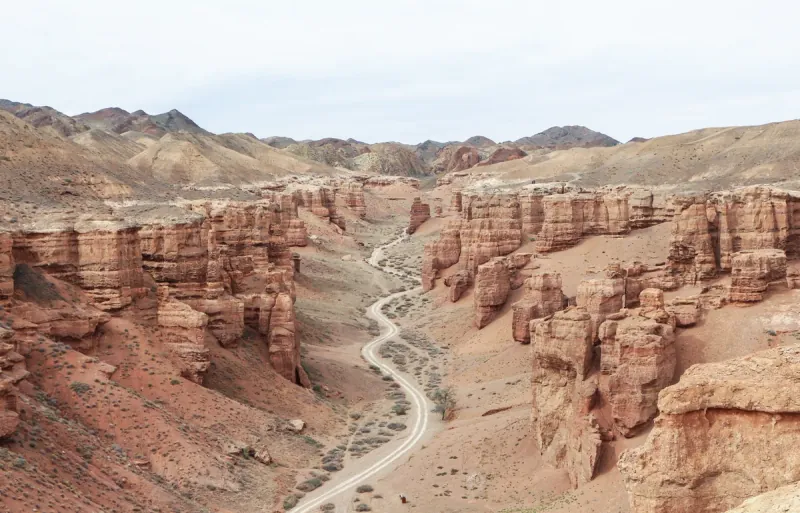
Kazakhstan is the world's ninth-largest country and largest landlocked nation. The landscape is vast and varied: the Kazakh Steppe dominates the center, the Tien Shan and Altai mountains rise in the east and southeast, and deserts cover the south. The Caspian Sea forms the western border. Charyn Canyon rivals the Grand Canyon.
Culture & Tradition
Kazakh culture is rooted in nomadic traditions. Horsemanship, eagle hunting, and yurt living are central to heritage. Kazakh cuisine features beshbarmak (meat and noodles) and kumis (fermented mare's milk). The dombra (two-stringed instrument) is essential to traditional music. Modern Kazakhstan blends Soviet legacy with Turkic and Islamic traditions.
Economy
Kazakhstan has the largest economy in Central Asia, driven by oil and gas exports from the Caspian region. Mining (uranium, chrome, zinc) is significant. Agriculture includes wheat and livestock. Astana has become a modern showcase city. The country is working to diversify through the Silk Road economic corridor.
Travel Highlights
Visit Astana's futuristic architecture (Bayterek Tower, Khan Shatyr), explore the stunning Charyn Canyon, discover the Baikonur Cosmodrome (space launch site), trek in the Altai Mountains, experience eagle hunting traditions, and visit the ancient Silk Road city of Turkestan with its Yasawi Mausoleum (UNESCO).
Fun Facts
Kazakhstan is the world's largest landlocked country.
The Baikonur Cosmodrome launches all Russian space missions.
Apples originated in Kazakhstan.
Kazakhstan spans two time zones.
The country has the world's second-largest uranium reserves.
Astana's futuristic architecture was designed by world-renowned architects.
Map
Bordering & Nearby Countries
Frequently Asked Questions (FAQs)
More from Asia
Want a surprise? Try our random Asia country generator or pick from the entire world.
Afghanistan
Discover Afghanistan: Hindu Kush mountains and ancient Silk Road heritage. Explore Bamiyan Valley, Herat's architecture, and Afghan culture.
Armenia
Explore Armenia: first Christian nation. Discover ancient monasteries, Lake Sevan, and Caucasus mountain heritage.
Azerbaijan
Explore Azerbaijan: Land of Fire. Discover Baku's Flame Towers, ancient walled city, mud volcanoes, and Caspian Sea heritage.

Bahrain
Explore Bahrain: ancient Dilmun heritage and modern Gulf culture. Discover pearl diving history, Formula One, and island archipelago charm.