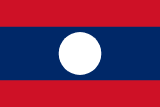
Laos – Facts, Capital & Geography | Random Country Generator
Capital
Vientiane
Population
7.5 Million (#102)
Currency
Lao Kip (LAK)
Language
Lao
Area
236,800 km²
National Dish
Laap
National Flower
Champa
Density
30/km²
Internet TLD
.la
Brief History
Laos was unified in 1353 under the Kingdom of Lan Xang ('Land of a Million Elephants') before splitting into regional kingdoms and becoming a French protectorate in 1893. It achieved independence in 1953, falling into a civil war that became embroiled in the Vietnam War, leading to heavy US bombing. The communist Pathet Lao took control in 1975, establishing a single-party state.
Key Demographics & Capital
Laos has a population of approximately 7.5 million, comprising 49 officially recognized ethnic groups, divided into three main categories: Lao Loum (lowland, 60%), Lao Theung (mid-slope, 24%), and Lao Soung (highland, 10%). Lao is the official language, written in its own script. The population is overwhelmingly young and predominantly rural (65%).
Geography
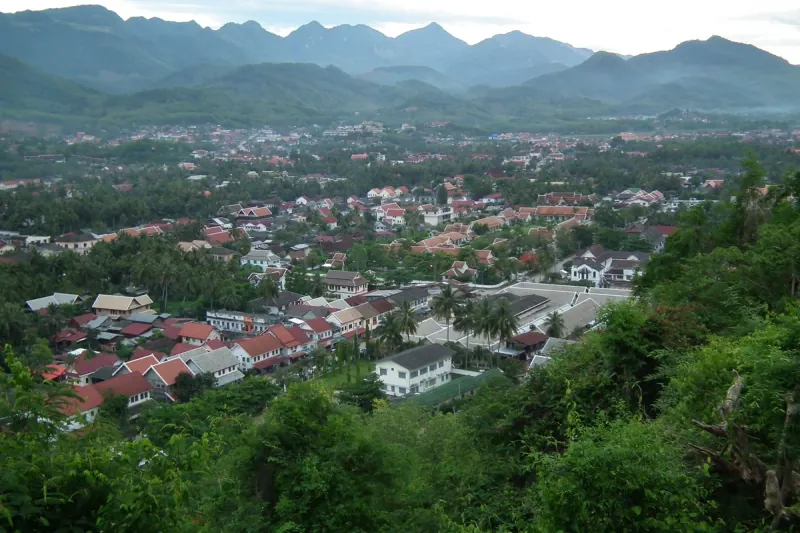
Laos is a landlocked country in Southeast Asia, dominated by mountains and the Mekong River valley. About 70% of the country is mountainous. The Mekong River forms much of the western border. Tropical forests cover much of the landscape. The Bolaven Plateau in the south has waterfalls and coffee plantations.
Culture & Tradition
Lao culture is deeply Buddhist, with gilded temples (wats) in every community. The daily alms-giving ceremony in Luang Prabang is a living tradition. Lao cuisine features larb, sticky rice, and Beerlao. Traditional weaving produces distinctive silk textiles. The country has a relaxed pace of life. Baci ceremonies are important social rituals.
Economy
Laos is developing rapidly with hydroelectric power exports (to Thailand and Vietnam), mining (copper, gold), agriculture, and growing tourism. The China-Laos railway is transforming connectivity. Subsistence farming employs most of the rural population. The country remains one of the least developed in Southeast Asia.
Travel Highlights
Explore the UNESCO-listed Luang Prabang with its temples and night market, cruise the Mekong River, visit the mysterious Plain of Jars, discover Kuang Si Waterfalls, experience the 4,000 Islands (Si Phan Don) region, and explore Vientiane's Buddhist monuments. Laos offers a more authentic, less touristy Southeast Asian experience.
Fun Facts
Laos is the most heavily bombed country per capita in history.
Luang Prabang is one of Southeast Asia's best-preserved cities.
The Mekong River runs the length of the country.
Laos has no railway system (a China-Laos railway opened in 2021).
Sticky rice is the staple food, eaten at every meal.
The Plain of Jars contains thousands of mysterious stone jars.
Map
Bordering & Nearby Countries
Frequently Asked Questions (FAQs)
More from Asia
Want a surprise? Try our random Asia country generator or pick from the entire world.
Afghanistan
Discover Afghanistan: Hindu Kush mountains and ancient Silk Road heritage. Explore Bamiyan Valley, Herat's architecture, and Afghan culture.
Armenia
Explore Armenia: first Christian nation. Discover ancient monasteries, Lake Sevan, and Caucasus mountain heritage.
Azerbaijan
Explore Azerbaijan: Land of Fire. Discover Baku's Flame Towers, ancient walled city, mud volcanoes, and Caspian Sea heritage.

Bahrain
Explore Bahrain: ancient Dilmun heritage and modern Gulf culture. Discover pearl diving history, Formula One, and island archipelago charm.