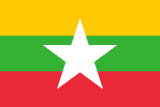
Myanmar – Facts, Capital & Geography | Random Country Generator
Capital
Naypyidaw
Population
54.4 Million (#26)
Currency
Myanmar Kyat (MMK)
Language
Burmese
Area
676,578 km²
National Dish
Mohinga
National Flower
Padauk
Density
82/km²
Internet TLD
.mm
Brief History
Myanmar (formerly Burma) was unified under the Pagan Kingdom in 1044, which made Theravada Buddhism the state religion before Mongol invasions. It was ruled by the Taungoo and Konbaung dynasties before British annexation after three Anglo-Burmese Wars in the 19th century. Myanmar achieved independence on January 4, 1948, under U Nu, subsequently undergoing decades of military dictatorship and civil conflicts.
Key Demographics & Capital
Myanmar has a population of approximately 54 million, comprising 135 officially recognized ethnic groups, with the Bamar (Burman) comprising over 68% of the total population. Burmese is the sole official language, written in its own circular script. The population is predominantly rural (over 68%), concentrated in the central Irrawaddy river basin and major cities like Yangon and Mandalay.
Geography
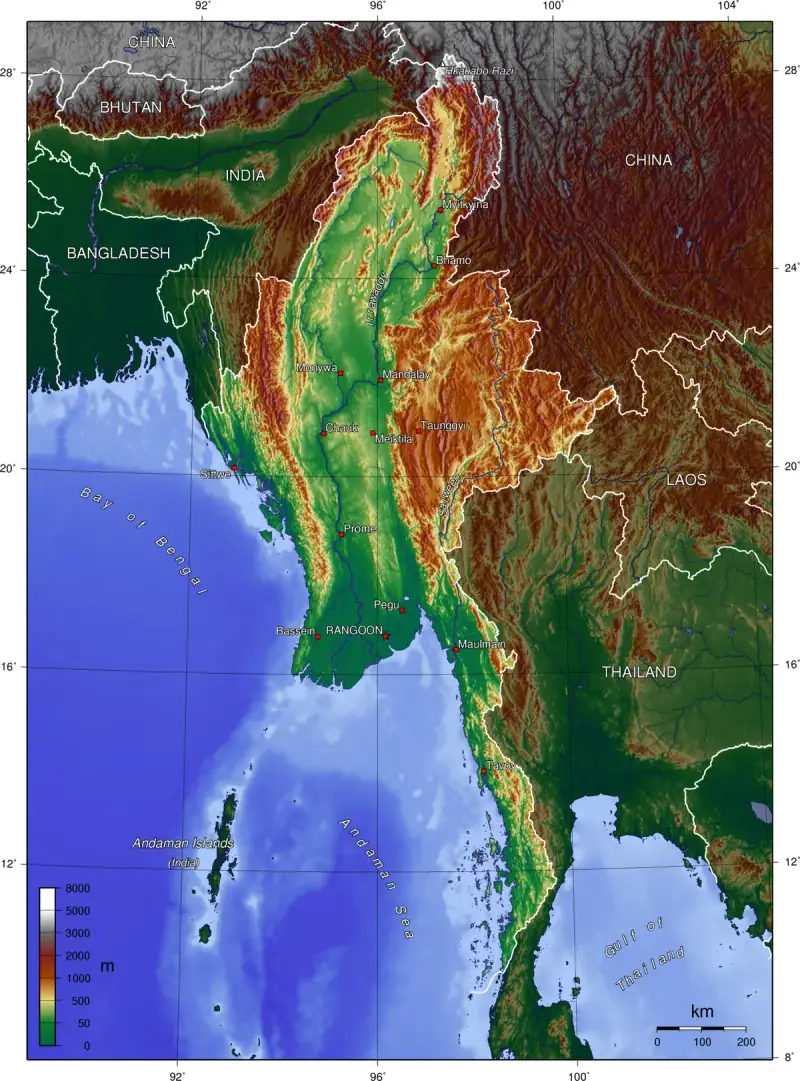
Myanmar is the largest country in mainland Southeast Asia. The landscape features the Irrawaddy River valley, surrounding mountain ranges, tropical coastline, and the Shan Plateau. The country has dense tropical forests, the delta region in the south, and snow-capped peaks in the far north. Inle Lake sits in a scenic highland valley.
Culture & Tradition
Myanmar's culture is deeply Buddhist, with golden pagodas and monasteries defining the landscape. The ancient city of Bagan has over 2,000 surviving temples. Traditional arts include lacquerware, puppet shows, and chinlone (cane ball sport). The thanaka face paste and longyi (sarong) are distinctive cultural markers. Myanmar has remarkable ethnic and linguistic diversity.
Economy
Myanmar's economy has faced significant challenges due to political instability. Agriculture (rice), natural gas, jade and gemstone mining, and garment manufacturing are key sectors. The country has significant natural resources including teak, minerals, and offshore gas. Economic development has been hampered by sanctions and conflict.
Travel Highlights
Explore the thousands of temples at Bagan at sunrise, visit the golden Shwedagon Pagoda in Yangon, cruise Inle Lake to see leg-rowing fishermen and floating gardens, discover the ancient city of Mandalay, trek in the Shan Highlands, and explore the temples of Mrauk U. Myanmar offers unforgettable cultural experiences.
Fun Facts
Myanmar has over 10,000 Buddhist temples in Bagan alone.
Myanmar is the world's largest producer of jade.
The country was known as Burma until 1989.
Inle Lake has unique leg-rowing fishermen.
Myanmar has 135 officially recognized ethnic groups.
The Shwedagon Pagoda is covered in real gold.
Map
Bordering & Nearby Countries
Frequently Asked Questions (FAQs)
More from Asia
Want a surprise? Try our random Asia country generator or pick from the entire world.
Afghanistan
Discover Afghanistan: Hindu Kush mountains and ancient Silk Road heritage. Explore Bamiyan Valley, Herat's architecture, and Afghan culture.
Armenia
Explore Armenia: first Christian nation. Discover ancient monasteries, Lake Sevan, and Caucasus mountain heritage.
Azerbaijan
Explore Azerbaijan: Land of Fire. Discover Baku's Flame Towers, ancient walled city, mud volcanoes, and Caspian Sea heritage.

Bahrain
Explore Bahrain: ancient Dilmun heritage and modern Gulf culture. Discover pearl diving history, Formula One, and island archipelago charm.