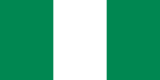
Nigeria – Facts, Capital & Geography | Random Country Generator
Capital
Abuja
Population
218.5 Million (#6)
Currency
Nigerian Naira (NGN)
Language
English
Area
923,768 km²
National Dish
Jollof Rice
National Flower
Costus spectabilis
Density
226/km²
Internet TLD
.ng
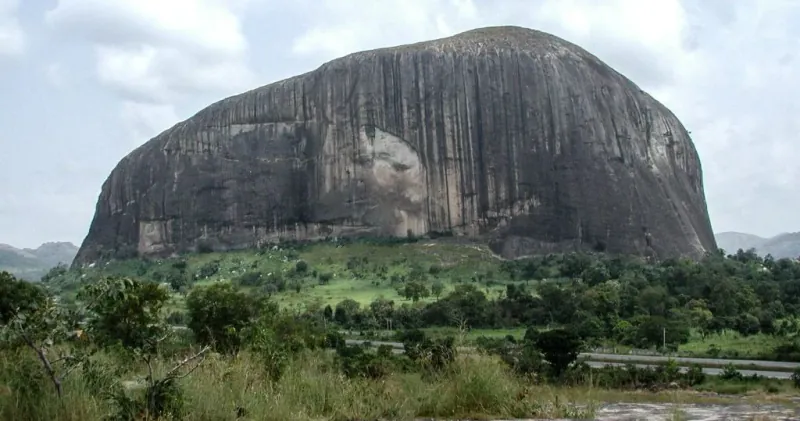
Brief History
Nigeria was the seat of ancient civilizations, including the Nok culture, the Nri Kingdom, the Oyo Empire, and the Sokoto Caliphate, before British colonization in the 19th and early 20th centuries. It achieved independence on October 1, 1960, under Nnamdi Azikiwe. The country fell into a civil war (1967–1970) over the secession of Biafra, followed by decades of military rule before democracy was restored in 1999.
Key Demographics & Capital
Nigeria has a population of approximately 224 million, making it the most populous nation in Africa. It comprises over 250 ethnic groups, with the Hausa-Fulani (30%) in the north, Yoruba (15.5%) in the southwest, and Igbo (15.2%) in the southeast being the largest. English is the official language, while Hausa, Yoruba, and Igbo are widely spoken. The population is divided equally between cities and rural areas.
Geography
Nigeria is in West Africa, with a coastline along the Gulf of Guinea. The landscape includes tropical forests in the south, savanna in the center, and semi-arid conditions in the north near Lake Chad. The Niger and Benue Rivers are major waterways. Nigeria has diverse ecosystems including mangrove swamps, rainforests, and grasslands.
Culture & Tradition
Nigeria is incredibly culturally diverse with major ethnic groups including the Yoruba, Igbo, and Hausa. Nigerian music (Afrobeats, exemplified by Burna Boy and Wizkid) has taken the world by storm. Literature boasts Nobel laureate Wole Soyinka and acclaimed author Chimamanda Ngozi Adichie. Nollywood produces thousands of films annually. Nigerian fashion is bold and influential.
Economy
Nigeria has Africa's largest economy, driven primarily by oil and gas exports. The country is diversifying into technology (Lagos is becoming a tech hub), telecommunications, agriculture, and financial services. The Nigerian diaspora contributes significantly through remittances. E-commerce and fintech are rapidly growing sectors.
Travel Highlights
Explore Lagos's vibrant nightlife and art scene, visit the ancient Benin City walls, relax on beaches in Lagos and Calabar, and experience the Osun-Osogbo Sacred Grove (UNESCO site). The Yankari National Park offers wildlife viewing. Nigerian street food and markets provide authentic cultural experiences.
Fun Facts
Nigeria is Africa's most populous country.
Nollywood (Nigerian cinema) is the world's second-largest film industry by volume.
Nigeria has over 250 ethnic groups and 500 languages.
Lagos is one of the fastest-growing cities in the world.
Nigeria is Africa's largest oil producer.
The Yoruba people have one of the highest rates of twin births in the world.
Map
Bordering & Nearby Countries
Frequently Asked Questions (FAQs)
More from Africa
Want a surprise? Try our random Africa country generator or pick from the entire world.
Algeria
Discover Algeria: Africa's largest country. From Saharan landscapes to Mediterranean coasts, explore ancient ruins and Berber culture.
Angola
Explore Angola: from Kalandula Falls to Atlantic beaches. Discover vibrant culture, wildlife, and Southern African landscapes.
Benin
Discover Benin: birthplace of Voodoo. Explore Dahomey palaces, floating villages, and rich West African traditions.
Botswana
Explore Botswana: home of the Okavango Delta and incredible safaris. Discover elephants, Kalahari landscapes, and African wilderness.