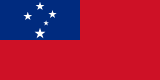
Samoa – Facts, Capital & Geography | Random Country Generator
Capital
Apia
Population
220K (#175)
Currency
Samoan Tālā (WST)
Language
Samoan, English
Area
2,842 km²
National Dish
Palusami
National Flower
Teuila
Density
70/km²
Internet TLD
.ws
Brief History
Samoa was settled by Polynesian groups over 3,000 years ago, developing a distinct social structure centered on the fa'amatai chieftain system. It was partitioned in 1899 under the Tripartite Treaty, with Germany taking Western Samoa and the United States taking Eastern Samoa. Administered by New Zealand after WWI, Western Samoa became the first Pacific island nation to achieve independence on January 1, 1962.
Key Demographics & Capital
Samoa has a population of approximately 220,000, presenting a highly homogeneous demographic profile with ethnic Samoans comprising over 96% of the population. Both Samoan and English are the official languages. The population remains predominantly rural (80%), concentrated along the coastal areas of Upolu Island, and the country has experienced high rates of emigration to New Zealand and American Samoa.
Geography
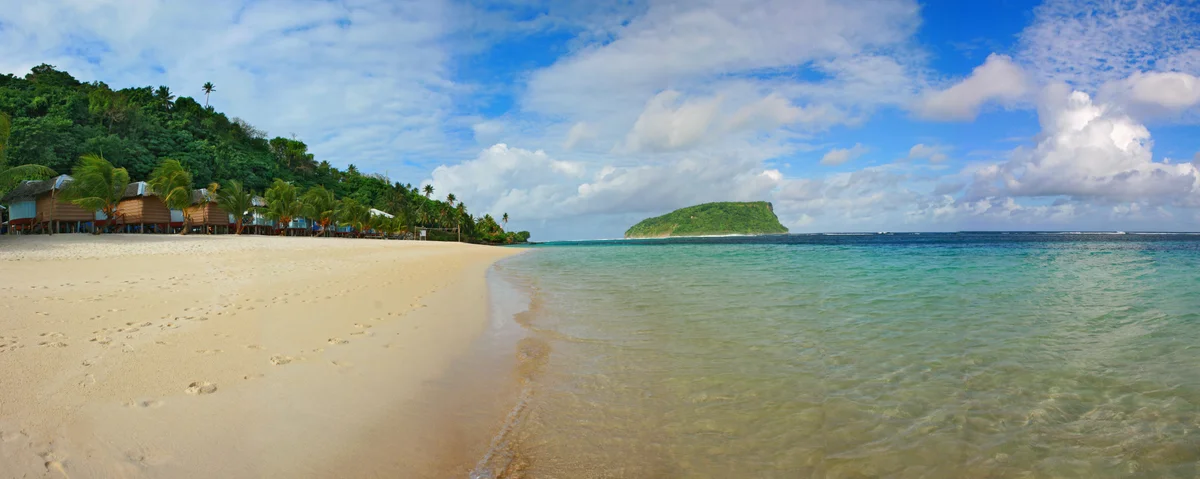
Samoa consists of two main volcanic islands (Upolu and Savai'i) and several smaller ones in the South Pacific. The islands feature volcanic peaks, tropical rainforests, waterfalls, and beautiful beaches. Savai'i has dramatic lava fields from a 1905 eruption. The islands are surrounded by coral reefs.
Culture & Tradition
Samoan culture follows the fa'a Samoa (Samoan Way) — a communal system centered on family (aiga), village chiefs (matai), and church. Traditional practices include the pe'a (male tattoo) and malu (female tattoo), which are sacred. Samoan dance (siva), music, and the fire knife dance (siva afi) are cultural highlights. Sunday is a day of rest and church.
Economy
Samoa's economy relies on agriculture (coconut, cocoa, banana), fishing, tourism, and remittances from Samoans abroad. Tourism is growing, centered on cultural experiences and natural beauty. Manufacturing includes auto parts for export. The country maintains a strong traditional economy alongside the modern sector.
Travel Highlights
Swim in the To Sua Ocean Trench (a stunning natural swimming hole), explore Savai'i's lava fields and blowholes, visit Robert Louis Stevenson's museum, experience a traditional Sunday feast (to'onai), discover Lalomanu Beach, explore tropical waterfalls, and participate in a traditional ava (kava) ceremony. Samoa offers authentic Polynesian culture.
Fun Facts
Samoa was formerly known as Western Samoa.
Robert Louis Stevenson spent his last years in Samoa and is buried there.
Samoa skipped December 30, 2011, when it moved across the International Date Line.
The fa'a Samoa (Samoan Way) governs traditional communal life.
Samoa is the first Polynesian country to gain independence.
Traditional Samoan tattooing (pe'a/malu) is a sacred practice.
Map
Bordering & Nearby Countries
Frequently Asked Questions (FAQs)
More from Oceania
Want a surprise? Try our random Oceania country generator or pick from the entire world.

Australia
Explore Australia: from the Great Barrier Reef to the Outback. Discover unique wildlife, stunning landscapes, and vibrant cities.
Fiji
Explore Fiji: 330 islands of South Pacific paradise. Discover pristine reefs, warm Fijian hospitality, and tropical island adventures.
Kiribati
Explore Kiribati: remote Pacific atolls spanning the equator. Discover WWII history, traditional culture, and pristine ocean environments.
Marshall Islands
Explore the Marshall Islands: remote Pacific atolls and nuclear history. Discover world-class diving, stick chart navigation, and island culture.