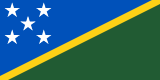
Solomon Islands – Facts, Capital & Geography | Random Country Generator
Capital
Honiara
Population
700K (#161)
Currency
Solomon Islands Dollar (SBD)
Language
English
Area
28,896 km²
National Dish
Poi
National Flower
None official
Density
23/km²
Internet TLD
.sb
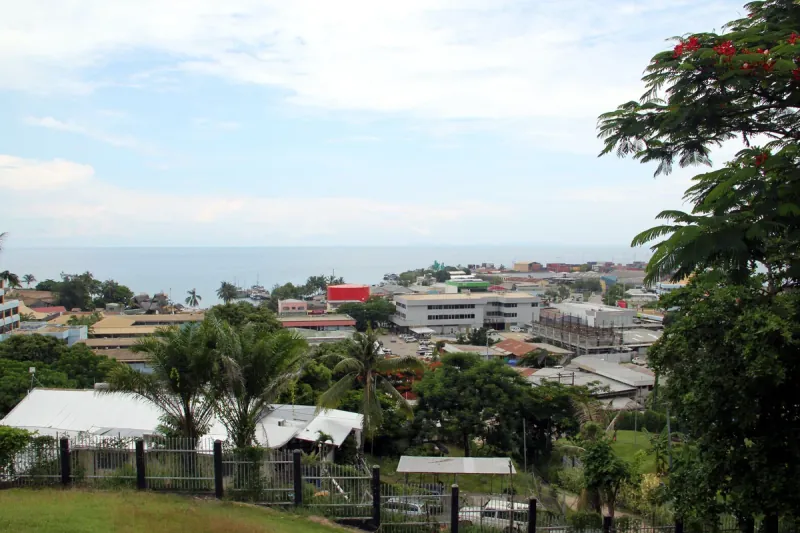
Brief History
The Solomon Islands was settled by Melanesian groups before Spanish explorer Álvaro de Mendaña arrived in 1568, naming them after King Solomon's wealth. It became a British protectorate in 1893. The islands were the scene of some of the most intense battles of WWII, most notably the Guadalcanal Campaign. The Solomon Islands achieved full independence on July 7, 1978, under Peter Kenilorea.
Key Demographics & Capital
The Solomon Islands has a population of approximately 750,000, with ethnic Melanesians comprising over 95% of the total population. English is the official language, while Tok Pisin (Melanesian Pidgin) serves as the primary commercial lingua franca. The population density is low, with residents clustered heavily along the coastal areas of the main islands, leaving the interior mountains sparsely populated.
Geography
The Solomon Islands is a Melanesian archipelago of about 990 islands in the South Pacific. The major islands are volcanic with mountainous interiors, tropical rainforests, and surrounding coral reefs. Marovo Lagoon is the world's largest saltwater lagoon. The islands lie in the Coral Triangle, the global epicenter of marine biodiversity.
Culture & Tradition
Solomon Islands culture is diverse across its many islands. Traditional customs (kastom) vary by region. Woodcarving, shell money, and panpipe music are cultural highlights. WWII history is deeply embedded in national identity, particularly around Guadalcanal. Many communities maintain traditional lifestyles. Over 70 languages are spoken.
Economy
The Solomon Islands economy relies on logging, fishing, agriculture (palm oil, cocoa, coconut), and aid. Logging has been a major but unsustainable revenue source. Tuna fishing is significant. Tourism has potential but is limited by remoteness and infrastructure. Gold mining is developing.
Travel Highlights
Dive the WWII wrecks and pristine reefs around Guadalcanal and the Florida Islands, explore the vast Marovo Lagoon, visit traditional villages and see skull shrines, discover the Kennedy Island (where JFK swam after his PT boat sank), and experience Melanesian culture. The Solomons offer raw, unspoiled Pacific adventure.
Fun Facts
The Solomon Islands were the scene of fierce WWII battles including Guadalcanal.
The islands have the world's largest saltwater lagoon (Marovo Lagoon).
Blond hair naturally occurs in some Melanesian Solomon Islanders.
Skull Island holds ancestral skulls in a sacred shrine.
The islands have incredible marine biodiversity.
Shell money is still used in some traditional exchanges.
Map
Bordering & Nearby Countries
Frequently Asked Questions (FAQs)
More from Oceania
Want a surprise? Try our random Oceania country generator or pick from the entire world.

Australia
Explore Australia: from the Great Barrier Reef to the Outback. Discover unique wildlife, stunning landscapes, and vibrant cities.
Fiji
Explore Fiji: 330 islands of South Pacific paradise. Discover pristine reefs, warm Fijian hospitality, and tropical island adventures.
Kiribati
Explore Kiribati: remote Pacific atolls spanning the equator. Discover WWII history, traditional culture, and pristine ocean environments.
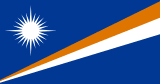
Marshall Islands
Explore the Marshall Islands: remote Pacific atolls and nuclear history. Discover world-class diving, stick chart navigation, and island culture.