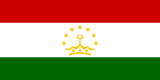
Tajikistan – Facts, Capital & Geography | Random Country Generator
Capital
Dushanbe
Population
10.1 Million (#91)
Currency
Tajikistani Somoni (TJS)
Language
Tajik
Area
143,100 km²
National Dish
Qurutob
National Flower
None official
Density
68/km²
Internet TLD
.tj
Brief History
Tajikistan's historical heritage is closely linked with the medieval Samanid Empire, which championed Persian culture in the 9th and 10th centuries. The territory was conquered by the Russian Empire in the late 19th century and later incorporated into the Soviet Union as a constituent republic. Tajikistan achieved full independence on September 9, 1991, following the collapse of the USSR. The nation immediately fell into a devastating civil war from 1992 to 1997, which ended with a peace agreement overseen by the United Nations.
Key Demographics & Capital
Tajikistan has a population of approximately 10.1 million, with ethnic Tajiks making up about 84% of the population, followed by an Uzbek minority of around 12%. Tajik, a variety of Persian, is the official state language, while Russian is widely used in business and inter-ethnic communication. The population is predominantly rural, with only about 26% living in urban centers like the capital, Dushanbe. A significant portion of the workforce migrates seasonally to Russia for employment, contributing heavily to the national economy through remittances.
Geography
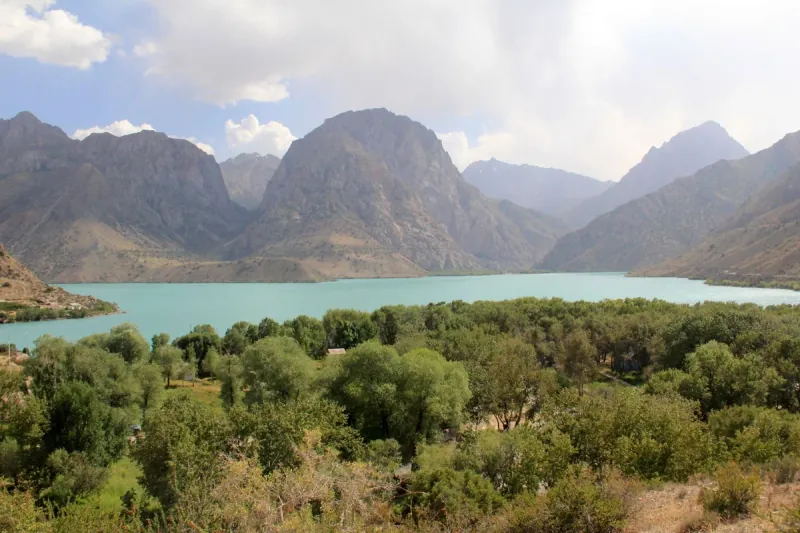
Tajikistan is a mountainous, landlocked country in Central Asia. Over 90% of the territory is mountainous, with the Pamir Mountains (Roof of the World) and Tien Shan ranges dominating. The country has the highest average elevation of any former Soviet republic. Glaciers and high-altitude lakes dot the landscape. The Fergana Valley in the north is the main lowland.
Culture & Tradition
Tajik culture is Persian-influenced, distinct from the Turkic cultures of neighboring countries. Persian poetry (Rumi was born in the region) is revered. Traditional music features the rubab and doyra instruments. Tajik cuisine centers on plov and other Central Asian dishes. Handcrafted suzani embroidery is a renowned art form.
Economy
Tajikistan is one of the poorest countries in Central Asia. The economy relies on aluminum production, cotton, remittances from migrant workers (mainly in Russia), and hydroelectric power. The country has vast hydroelectric potential. Mining (gold, silver) is growing. Agriculture employs much of the population.
Travel Highlights
Drive the legendary Pamir Highway through stunning mountain passes, explore the Wakhan Corridor views, visit Iskanderkul (Alexander's Lake), trek in the Fan Mountains, discover Dushanbe's museums, and experience Pamiri hospitality in homestays. Tajikistan offers some of Central Asia's most dramatic mountain scenery.
Fun Facts
Over 90% of Tajikistan is mountainous.
The Pamir Highway is one of the world's highest and most scenic roads.
Ismoil Somoni Peak is the highest point in Central Asia.
Tajikistan has the world's second-highest dam (Nurek Dam).
The Pamir region is called the 'Roof of the World.'
Tajik cuisine features plov (rice pilaf) as the national dish.
Map
Bordering & Nearby Countries
Frequently Asked Questions (FAQs)
More from Asia
Want a surprise? Try our random Asia country generator or pick from the entire world.
Afghanistan
Discover Afghanistan: Hindu Kush mountains and ancient Silk Road heritage. Explore Bamiyan Valley, Herat's architecture, and Afghan culture.
Armenia
Explore Armenia: first Christian nation. Discover ancient monasteries, Lake Sevan, and Caucasus mountain heritage.
Azerbaijan
Explore Azerbaijan: Land of Fire. Discover Baku's Flame Towers, ancient walled city, mud volcanoes, and Caspian Sea heritage.

Bahrain
Explore Bahrain: ancient Dilmun heritage and modern Gulf culture. Discover pearl diving history, Formula One, and island archipelago charm.