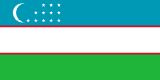
Uzbekistan – Facts, Capital & Geography | Random Country Generator
Capital
Tashkent
Population
35.6 Million (#42)
Currency
Uzbekistani Som (UZS)
Language
Uzbek
Area
448,978 km²
National Dish
Plov
National Flower
White Cotton Blossom
Density
79/km²
Internet TLD
.uz
Brief History
Uzbekistan was home to ancient cities like Samarkand and Bukhara, which flourished as major centers along the Silk Road and Islamic Golden Age under the Timurid Empire. The territory was conquered by the Russian Empire in the 19th century and later became a constituent republic of the Soviet Union in 1924. Uzbekistan achieved independence on August 31, 1991, under Islam Karimov, who ruled with a highly centralized authority. Following Karimov's death in 2016, the country initiated significant economic and political reforms to open its economy.
Key Demographics & Capital
Uzbekistan has a population of approximately 35.6 million, making it the most populous country in Central Asia. Ethnic Uzbeks make up over 84% of the population, followed by Tajik (5%), Kazakh (3%), and Russian (2%) minorities. Uzbek, a Turkic language, is the sole official state language, while Russian is widely used in government and business. The population is relatively young and concentrated in the fertile Fergana Valley and Tashkent oasis, while the Kyzylkum Desert remains sparsely populated.
Geography
Uzbekistan is a doubly landlocked country in Central Asia. The landscape includes the Kyzylkum Desert, the fertile Fergana Valley, and the remnants of the Aral Sea. The western part is dominated by the Karakalpakstan plateau. The eastern mountains reach into the Tien Shan range. The Amu Darya and Syr Darya rivers flow through the country.
Culture & Tradition
Uzbek culture is defined by its extraordinary Silk Road heritage. Samarkand, Bukhara, and Khiva showcase some of the finest Islamic architecture in the world. Traditional crafts include silk weaving, ceramics, and metalwork. Uzbek cuisine centers on plov (rice pilaf), bread (non), and hospitality. The country has a rich tradition of miniature painting and music.
Economy
Uzbekistan has the most diversified economy in Central Asia. Cotton, gold, natural gas, and copper are major exports. The country is reforming and opening its economy. Tourism is growing rapidly around Silk Road heritage sites. Agriculture, particularly cotton and fruits, employs many people. Manufacturing and services are developing.
Travel Highlights
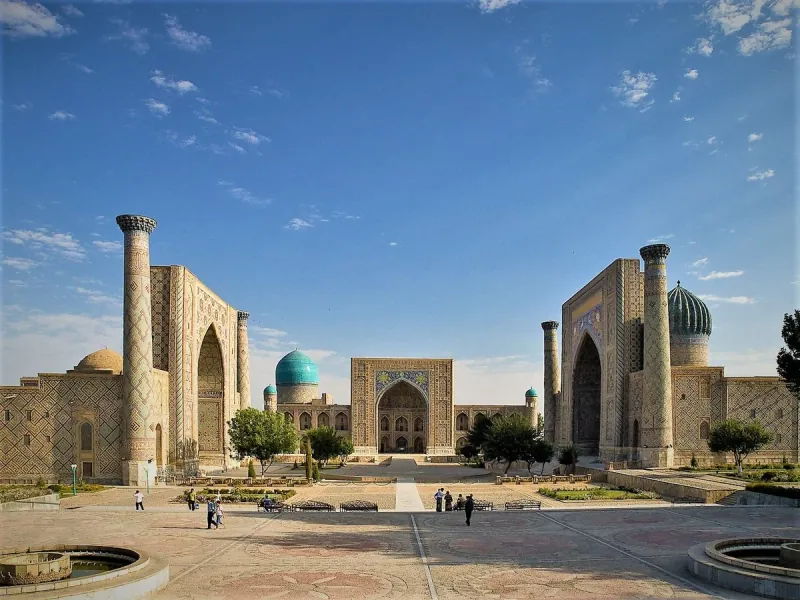
Marvel at the Registan Square in Samarkand, explore the medieval city of Bukhara with its madrasahs and minarets, walk through the walled inner city of Khiva (UNESCO), visit the Aral Sea ship graveyard in Moynaq, experience a Tashkent metro tour (Soviet-era art stations), and stay in traditional guesthouses. Uzbekistan is Central Asia's premier cultural destination.
Fun Facts
Samarkand was a key city on the ancient Silk Road.
The Registan in Samarkand is considered one of the most beautiful squares in the world.
Uzbekistan is the world's sixth-largest cotton producer.
The country is doubly landlocked (you must cross two countries to reach the sea).
The Aral Sea disaster is one of the world's worst environmental catastrophes.
Uzbek plov (rice pilaf) has hundreds of regional variations.
Map
Bordering & Nearby Countries
Frequently Asked Questions (FAQs)
More from Asia
Want a surprise? Try our random Asia country generator or pick from the entire world.
Afghanistan
Discover Afghanistan: Hindu Kush mountains and ancient Silk Road heritage. Explore Bamiyan Valley, Herat's architecture, and Afghan culture.
Armenia
Explore Armenia: first Christian nation. Discover ancient monasteries, Lake Sevan, and Caucasus mountain heritage.
Azerbaijan
Explore Azerbaijan: Land of Fire. Discover Baku's Flame Towers, ancient walled city, mud volcanoes, and Caspian Sea heritage.

Bahrain
Explore Bahrain: ancient Dilmun heritage and modern Gulf culture. Discover pearl diving history, Formula One, and island archipelago charm.