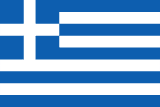
Greece – Facts, Capital & Geography | Random Country Generator
Capital
Athens
Population
10.4 Million (#88)
Currency
Euro (EUR)
Language
Greek
Area
131,957 km²
National Dish
Moussaka
National Flower
Bear's Breach
Density
82/km²
Internet TLD
.gr
Brief History
Greece is the birthplace of Western civilization, home to ancient city-states (Athens and Sparta), philosophy, and the conquests of Alexander the Great. It fell under the Byzantine Empire and later Ottoman rule in 1453, remaining occupied for nearly four centuries before declaring independence in 1821. Following a brutal civil war and a military junta (1967–1974), Greece abolished its monarchy, joined the EU in 1981, and adopted the Euro in 2001.
Key Demographics & Capital
Greece has a population of approximately 10.3 million, exhibiting high ethnic homogeneity with over 93% identifying as Greek. Greek is the sole official language. The population has been declining due to low fertility rates and a youth 'brain drain' emigration wave following the 2010 financial crisis. Around 80% of the population lives in cities, primarily Athens and Thessaloniki.
Geography
Greece is located at the crossroads of Europe, Asia, and Africa, with mainland and thousands of islands in the Aegean and Ionian Seas. About 80% of the country is mountainous, with Mount Olympus as the highest peak. The coastline stretches over 13,000 km. The climate is Mediterranean with hot, dry summers and mild, wet winters.
Culture & Tradition
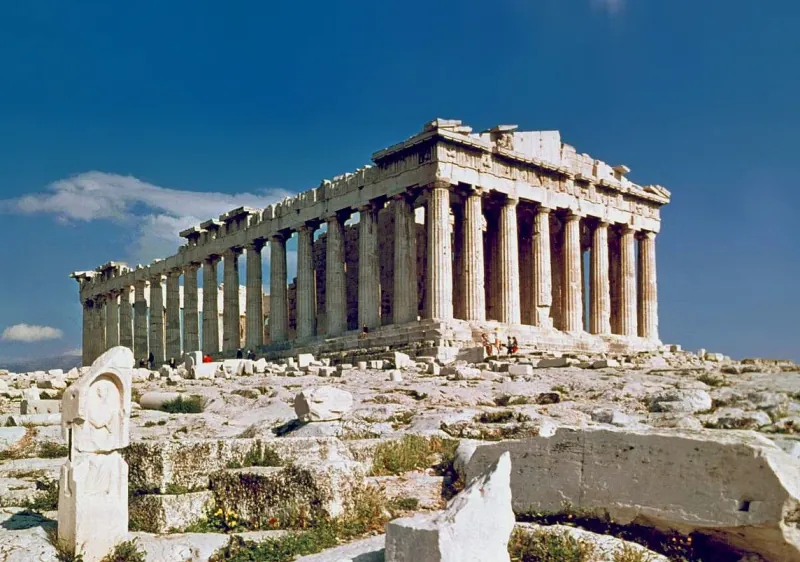
Greece is the cradle of Western civilization, birthplace of democracy, philosophy (Socrates, Plato, Aristotle), theater, and the Olympic Games. Greek mythology and ancient architecture (Parthenon, Acropolis) continue to captivate. Modern Greek culture features vibrant music (rebetiko, bouzouki), dance, and cuisine — Greek salad, moussaka, and souvlaki. Philoxenia (hospitality) is a cherished value.
Economy
Greece's economy is based on services (especially tourism), shipping (Greece has one of the world's largest merchant fleets), agriculture (olive oil, wine, feta cheese), and industry. Tourism accounts for about 20% of GDP. Athens is the economic center. Greece is recovering from a financial crisis and modernizing its economy.
Travel Highlights
Explore the Acropolis in Athens, sail the whitewashed islands of Santorini and Mykonos, visit the monasteries of Meteora perched on rock pillars, discover ancient Delphi, and relax on Crete's beaches. The Peloponnese offers ancient Olympia and charming Nafplio. Greek island hopping is a quintessential Mediterranean experience.
Fun Facts
Greece has more archaeological museums than any other country.
The marathon race is named after the Greek city of Marathon.
Greece has over 6,000 islands, but only about 227 are inhabited.
Democracy was born in Athens around 508 BC.
The Greek alphabet has been in use for over 2,700 years.
Greeks consume more olive oil per capita than any other nation.
Map
Bordering & Nearby Countries
Frequently Asked Questions (FAQs)
More from Europe
Want a surprise? Try our random Europe country generator or pick from the entire world.
Albania
Explore Albania: Europe's last hidden gem. Discover pristine beaches, ancient cities, and dramatic Albanian Alps.
Andorra
Explore Andorra: tiny mountain principality in the Pyrenees. Discover skiing, duty-free shopping, and Romanesque heritage.
Austria
Explore Austria: land of Mozart, Alpine peaks, and Viennese culture. Discover Salzburg, ski resorts, and Habsburg heritage.
Belarus
Explore Belarus: Europe's last primeval forest and medieval castles. Discover Belovezhskaya Pushcha, Mir Castle, and Slavic heritage.