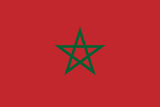
Morocco – Facts, Capital & Geography | Random Country Generator
Capital
Rabat
Population
37.0 Million (#39)
Currency
Moroccan Dirham (MAD)
Language
Arabic, Berber
Area
446,550 km²
National Dish
Couscous
National Flower
Rose
Density
82/km²
Internet TLD
.ma
Brief History
Morocco was inhabited by Berbers before adopting Islam in the 8th century under Idris I, who founded the Idrisid dynasty. It became a powerful empire under the Almoravid and Almohad dynasties, controlling much of Spain and North Africa. Morocco became a French and Spanish protectorate in 1912, regaining independence in 1956 under King Mohammed V, and has since focused on modernizing its economic hubs.
Key Demographics & Capital
Morocco has a population of approximately 37 million, with ethnic Arab-Berbers comprising over 99% of the total population. Arabic and Berber (Tamazight) are the two official languages, while Moroccan Arabic (Darija) is the primary spoken dialect. French is widely used in business and government. Over 64% of the population resides in urban areas, primarily in Casablanca and Rabat.
Geography
Morocco is located in northwest Africa, with coastlines on both the Atlantic Ocean and Mediterranean Sea. The Atlas Mountains cross the center of the country, while the Sahara Desert stretches across the southeast. The Rif Mountains line the northern coast. The climate ranges from Mediterranean along the coast to arid in the desert interior.
Culture & Tradition
Moroccan culture is a rich tapestry of Berber, Arab, and French influences. The medinas (old cities) of Fez and Marrakech are labyrinthine wonders. Moroccan cuisine features tagines, couscous, and pastilla. Traditional crafts include zellige tilework, leather goods, and carpet weaving. Music ranges from Gnawa to Chaabi. Hamams (bathhouses) are an important social tradition.
Economy
Morocco has a diverse economy with sectors including agriculture (citrus, olives, phosphates), manufacturing (automotive, aerospace), tourism, and renewable energy. Morocco is building one of the world's largest solar farms. The country is a gateway between Europe and Africa, with growing foreign investment and free trade zones.
Travel Highlights
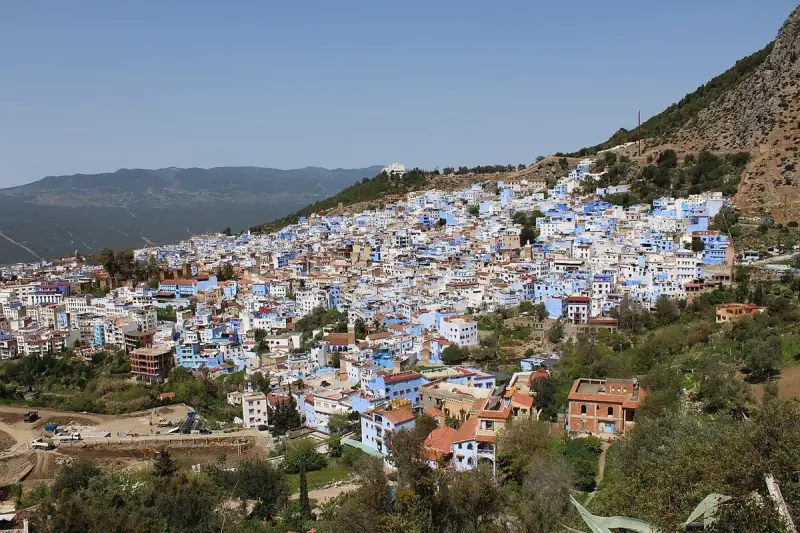
Get lost in the medinas of Marrakech and Fez, camp under the stars in the Sahara Desert, explore the blue city of Chefchaouen, visit the Roman ruins of Volubilis, and surf in Essaouira. The Atlas Mountains offer trekking opportunities, while Casablanca showcases modern Morocco. Moroccan riads (traditional guesthouses) provide unique accommodation.
Fun Facts
Morocco is home to the oldest university in the world, the University of al-Qarawiyyin.
The country produces about 40% of the world's phosphate.
Moroccan mint tea is a symbol of hospitality.
Morocco is only 14 km from Spain across the Strait of Gibraltar.
Argan oil, used in cooking and cosmetics, is unique to Morocco.
Marrakech's Jemaa el-Fna is one of the most vibrant squares in the world.
Map
Bordering & Nearby Countries
Frequently Asked Questions (FAQs)
More from Africa
Want a surprise? Try our random Africa country generator or pick from the entire world.
Algeria
Discover Algeria: Africa's largest country. From Saharan landscapes to Mediterranean coasts, explore ancient ruins and Berber culture.
Angola
Explore Angola: from Kalandula Falls to Atlantic beaches. Discover vibrant culture, wildlife, and Southern African landscapes.
Benin
Discover Benin: birthplace of Voodoo. Explore Dahomey palaces, floating villages, and rich West African traditions.
Botswana
Explore Botswana: home of the Okavango Delta and incredible safaris. Discover elephants, Kalahari landscapes, and African wilderness.