Vietnam – Facts, Capital & Geography | Random Country Generator
Capital
Hanoi
Population
99.0 Million (#16)
Currency
Vietnamese Dong (VND)
Language
Vietnamese
Area
331,212 km²
National Dish
Phở
National Flower
Lotus
Density
308/km²
Internet TLD
.vn
Brief History
Vietnam was ruled by various Chinese dynasties for over a millennium before achieving independence in 939 CE under Ngo Quyen, who defeated Chinese forces at the Bach Dang River. The country was colonized by France in the late 19th century and occupied by Japan during World War II, leading to a long struggle for independence led by Ho Chi Minh. Following the division of the country, the Vietnam War (1955-1975) ended with the fall of Saigon and the unification of North and South Vietnam under a communist government. In 1986, the government introduced the Doi Moi economic reforms, transitioning toward a market-oriented economy.
Key Demographics & Capital
Vietnam has a population of approximately 99 million, with the Kinh (ethnic Vietnamese) comprising about 85% of the population, followed by 53 officially recognized ethnic minorities. Vietnamese is the sole official language, written in the Latin alphabet with diacritical marks since its colonial adoption. The population is concentrated in the fertile delta regions of the Red River in the north and the Mekong River in the south, while the mountainous interior is less densely settled. The country is urbanizing rapidly, with major metropolitan centers like Ho Chi Minh City and Hanoi.
Geography
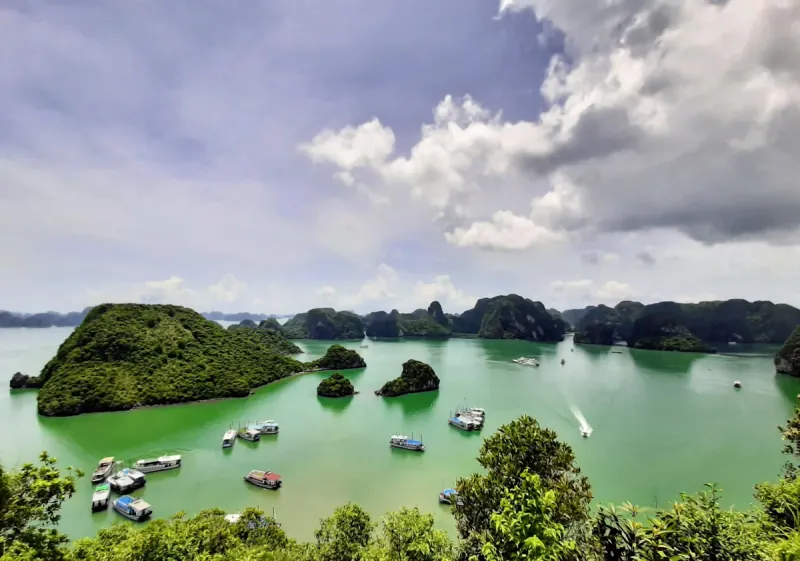
Vietnam stretches along the eastern coast of the Indochinese Peninsula in Southeast Asia. The country is narrow and elongated, featuring the Red River Delta in the north, the Mekong Delta in the south, and a mountainous interior. Halong Bay's limestone karsts, the Central Highlands, and extensive coastline with beautiful beaches define the landscape.
Culture & Tradition
Vietnamese culture is deeply influenced by Confucianism, Buddhism, and French colonialism. Vietnamese cuisine, featuring pho, banh mi, and fresh spring rolls, is celebrated globally for its balance of flavors. Traditional arts include silk painting, lacquerware, and ao dai (traditional dress). Family values and respect for elders are central. The water puppet shows of Hanoi are unique to Vietnam.
Economy
Vietnam is one of the world's fastest-growing economies. Manufacturing (electronics, textiles, footwear), agriculture (rice, coffee, seafood), and tourism drive growth. Vietnam has become a major destination for foreign manufacturing investment. Ho Chi Minh City is the business hub. The country has lifted millions out of poverty in recent decades.
Travel Highlights
Cruise through Halong Bay's emerald waters, explore the ancient town of Hoi An, trek in the rice terraces of Sapa, visit the Cu Chi Tunnels near Ho Chi Minh City, and discover the imperial citadel of Hue. The Mekong Delta's floating markets, Phong Nha caves, and Ninh Binh's 'Halong Bay on land' are unforgettable experiences.
Fun Facts
Vietnam is the world's second-largest coffee exporter after Brazil.
Motorbikes outnumber cars by about 50 to 1 in Vietnam.
Halong Bay has nearly 2,000 limestone islands.
Pho is eaten for breakfast, lunch, and dinner.
Vietnam has 8 UNESCO World Heritage Sites.
The Vietnamese water puppet theater tradition dates back to the 11th century.
Map
Bordering & Nearby Countries
Frequently Asked Questions (FAQs)
More from Asia
Want a surprise? Try our random Asia country generator or pick from the entire world.
Afghanistan
Discover Afghanistan: Hindu Kush mountains and ancient Silk Road heritage. Explore Bamiyan Valley, Herat's architecture, and Afghan culture.
Armenia
Explore Armenia: first Christian nation. Discover ancient monasteries, Lake Sevan, and Caucasus mountain heritage.
Azerbaijan
Explore Azerbaijan: Land of Fire. Discover Baku's Flame Towers, ancient walled city, mud volcanoes, and Caspian Sea heritage.

Bahrain
Explore Bahrain: ancient Dilmun heritage and modern Gulf culture. Discover pearl diving history, Formula One, and island archipelago charm.