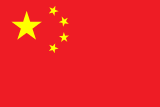
China – Facts, Capital & Geography | Random Country Generator
Capital
Beijing
Population
1.41 Billion (#2)
Currency
Chinese Yuan (CNY)
Language
Mandarin Chinese
Area
9,596,960 km²
National Dish
Peking Duck
National Flower
Plum Blossom
Density
148/km²
Internet TLD
.cn
Brief History
China is home to one of the world's oldest continuous civilizations, with a history spanning over 5,000 years. The rise and fall of imperial dynasties—from the Qin, Han, Tang, Song, Ming, to the Qing dynasty—shaped the nation's borders, philosophy (Confucianism, Taoism), and administrative structures. In 1912, the Republic of China was formed, ending imperial rule, and in 1949, the People's Republic of China was established under Mao Zedong. The late 20th century economic reforms catalyzed China's ascension to a global manufacturing and financial giant.
Key Demographics & Capital
China is home to over 1.4 billion people, representing a massive demographic force. The government officially recognizes 56 distinct ethnic groups, with the Han Chinese comprising roughly 91% of the total population. Mandarin Chinese (Putonghua) is the national language, alongside numerous regional languages and dialects like Cantonese. Population density is heavily skewed toward the eastern coastal provinces and major delta regions, while the western highlands remain sparsely populated.
Geography
China is the world's third-largest country by area, with incredibly diverse terrain. From the Himalayan Plateau in the west to the Pacific coastline in the east, landscapes include the Gobi Desert, tropical rainforests of Yunnan, the Yangtze and Yellow River valleys, and the vast Tibetan Plateau. China spans five geographical time zones.
Culture & Tradition
Chinese civilization is one of the world's oldest, spanning over 5,000 years. Contributions include Confucianism, Taoism, Chinese medicine, martial arts, calligraphy, porcelain, and silk. Chinese cuisine varies dramatically by region — Sichuan, Cantonese, Shandong, and Jiangsu styles are distinct. Chinese New Year is the most important festival. Tea culture and tai chi are daily practices for millions.
Economy
China has the world's second-largest economy and is the world's largest manufacturer and exporter. Key sectors include electronics, automotive, steel, textiles, and increasingly, technology (AI, 5G). China's Belt and Road Initiative is reshaping global trade. Major tech companies include Alibaba, Tencent, and Huawei. The country has experienced unprecedented economic growth in recent decades.
Travel Highlights
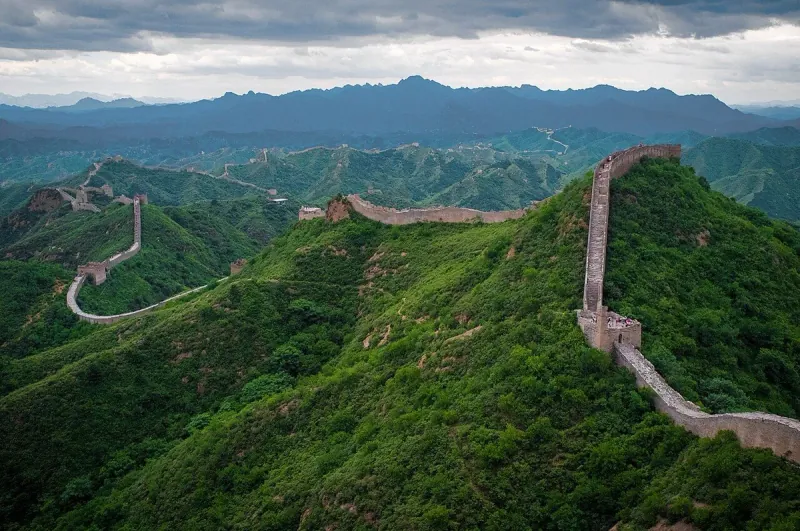
Walk the Great Wall, explore the Forbidden City in Beijing, visit the Terracotta Warriors in Xi'an, cruise the Li River in Guilin, explore Shanghai's modern skyline, and discover the giant pandas in Chengdu. Tibet's Potala Palace, the karst landscapes of Zhangjiajie (Avatar Mountains), and the ancient water towns near Shanghai offer diverse experiences.
Fun Facts
The Great Wall of China stretches over 21,000 km.
China invented paper, printing, gunpowder, and the compass.
Mandarin Chinese is the most spoken language in the world.
China has the world's largest high-speed rail network.
Giant pandas are found only in China.
Chinese New Year celebrations last 15 days.
Map
Bordering & Nearby Countries
Frequently Asked Questions (FAQs)
More from Asia
Want a surprise? Try our random Asia country generator or pick from the entire world.
Afghanistan
Discover Afghanistan: Hindu Kush mountains and ancient Silk Road heritage. Explore Bamiyan Valley, Herat's architecture, and Afghan culture.
Armenia
Explore Armenia: first Christian nation. Discover ancient monasteries, Lake Sevan, and Caucasus mountain heritage.

Azerbaijan
Explore Azerbaijan: Land of Fire. Discover Baku's Flame Towers, ancient walled city, mud volcanoes, and Caspian Sea heritage.

Bahrain
Explore Bahrain: ancient Dilmun heritage and modern Gulf culture. Discover pearl diving history, Formula One, and island archipelago charm.