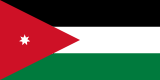
Jordan – Facts, Capital & Geography | Random Country Generator
Capital
Amman
Population
11.3 Million (#84)
Currency
Jordanian Dinar (JOD)
Language
Arabic
Area
89,342 km²
National Dish
Mansaf
National Flower
Black Iris
Density
116/km²
Internet TLD
.jo
Brief History
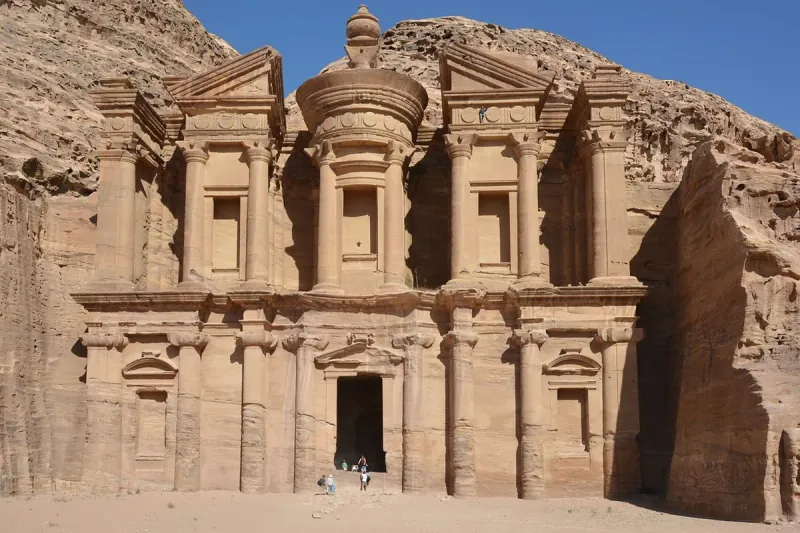
Jordan was home to the Nabataean civilization, which built the legendary city of Petra, later incorporated into the Roman and Ottoman empires. Following the collapse of the Ottoman Empire, the territory became the British protectorate of Transjordan in 1921. The country achieved full independence on May 25, 1946, as a Hashemite kingdom under King Abdullah I, later taking in millions of Palestinian and Syrian refugees.
Key Demographics & Capital
Jordan has a population of approximately 11.3 million, with ethnic Arabs comprising over 98% of the population. Arabic is the official language. Jordan's demographics have been profoundly shaped by regional conflicts, hosting one of the world's largest refugee populations, including over 2 million registered Palestinians and 1.3 million Syrian refugees, concentrated in urban areas.
Geography
Jordan is a Middle Eastern country bordered by Saudi Arabia, Iraq, Syria, Israel, and Palestine. The landscape features the Jordan Rift Valley, the Dead Sea (the lowest point on Earth at 430 meters below sea level), the arid Wadi Rum desert, and fertile highlands. The Red Sea coast at Aqaba provides the country's only access to the sea.
Culture & Tradition
Jordanian culture is rooted in Arab, Bedouin, and Islamic traditions. Hospitality is paramount — guests are treated with great generosity. Jordanian cuisine features mansaf, falafel, hummus, and Arabic coffee. The country has a rich archaeological heritage spanning Nabataean (Petra), Roman (Jerash), and Crusader periods. Modern Amman has a growing arts and cafe culture.
Economy
Jordan has a small, open economy with limited natural resources. Key sectors include services, tourism (Petra, Dead Sea), phosphate and potash mining, pharmaceuticals, and IT. Remittances from Jordanians abroad are significant. Jordan has positioned itself as a regional hub for education and healthcare. International aid also plays a role in the economy.
Travel Highlights
Explore the ancient city of Petra carved into rose-red cliffs, float in the Dead Sea, camp under the stars in Wadi Rum's desert landscape, visit the well-preserved Roman ruins of Jerash, and dive in the Red Sea at Aqaba. The Baptism Site of Jesus on the Jordan River, Dana Nature Reserve, and Amman's Citadel offer diverse experiences.
Fun Facts
Petra was voted one of the New Seven Wonders of the World.
The Dead Sea is the lowest point on Earth's surface.
Jordan is one of the safest countries in the Middle East.
Wadi Rum was used as a filming location for The Martian.
Jordan has no oil — unlike most of its neighbors.
Mansaf (lamb cooked in fermented yogurt) is the national dish.
Map
Bordering & Nearby Countries
Frequently Asked Questions (FAQs)
More from Asia
Want a surprise? Try our random Asia country generator or pick from the entire world.
Afghanistan
Discover Afghanistan: Hindu Kush mountains and ancient Silk Road heritage. Explore Bamiyan Valley, Herat's architecture, and Afghan culture.
Armenia
Explore Armenia: first Christian nation. Discover ancient monasteries, Lake Sevan, and Caucasus mountain heritage.
Azerbaijan
Explore Azerbaijan: Land of Fire. Discover Baku's Flame Towers, ancient walled city, mud volcanoes, and Caspian Sea heritage.

Bahrain
Explore Bahrain: ancient Dilmun heritage and modern Gulf culture. Discover pearl diving history, Formula One, and island archipelago charm.